Learn English
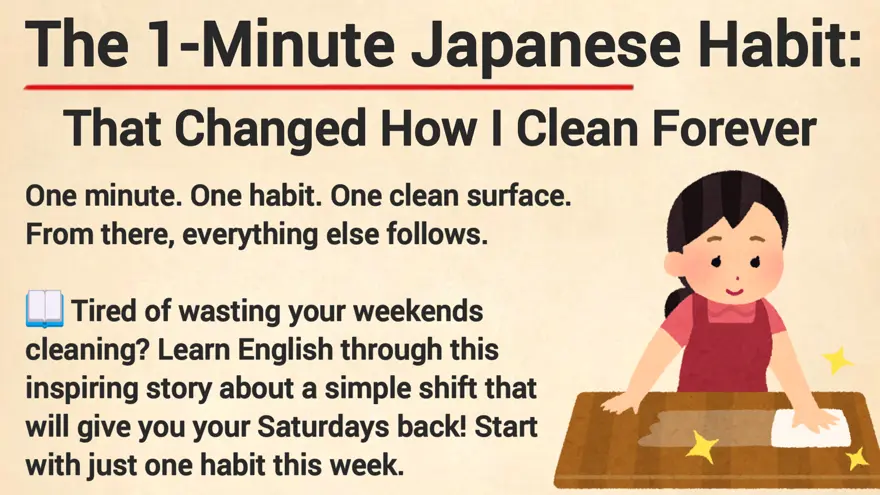
The 1-Minute Japanese Habit: Why I Stopped Cleaning on Weekends
Have you ever walked into someone’s home and immediately felt an unexplainable sense of complete peace?
It has nothing to do with expensive minimalist furniture or magazine-worthy interior design. Instead, it is a profound absence of visual tension. I experienced this exact feeling while visiting a close friend who had spent several years living in Japan. Her home felt like a sanctuary. When I asked for her secret—expecting a detailed cleaning schedule or a list of specialty products—she looked at me with a soft smile and said something that completely broke my brain:
“I just do small things all the time. Nothing takes more than a single minute.”
In Western culture, whether you live in the US, the UK, Europe, or Australia, we have all inherited the exact same approach to keeping house: The Event Model. We let things mess up, we tolerate the accumulation until it crosses our threshold of frustration, and then we sacrifice a massive block of our precious Saturday morning to a brutal “cleaning blitz.” It is reactive, cyclical, and utterly exhausting.
But there is a better way. Japanese cleaning philosophy completely escapes this trap through a single principle shift: preventing the drift before accumulation ever has a chance to develop.
In this post, I am breaking down the five simple, 1-minute daily habits that permanently destroyed my weekend cleaning routine. If you are tired of spending your days off with a scrub brush in hand, here is how a simple 60-second shift can give you your weekends back.
Chapter 1: The Invisible Difference
I still remember the exact afternoon everything changed for me.
I was visiting a close friend who had spent several years living in Japan. From the outside, her suburban home looked completely ordinary. It was a normal size. It had normal furniture. There was nothing expensive, minimalist, or magazine-worthy about it.
But the very moment I stepped across the threshold, something felt entirely different.
It was a feeling I could not immediately name, but I could absolutely feel it in my chest. The air inside the house felt lighter. The space possessed a profound sense of calm that had absolutely nothing to do with interior design or decoration. There was a total absence of tension—a quiet stillness that I had never once experienced in a home before, including my own.
I watched her walk through her spaces, moving with an easy, unbothered grace. Finally, I couldn’t help myself. I asked her how she kept her home looking and feeling this way. I fully expected her to share a complex cleaning schedule, a secret chemical product, or some revolutionary organizing system she had bought online.
Instead, she looked at me with a soft, almost confused smile.
“I just do small things all the time,” she said simply. “Nothing takes more than a single minute.”
I did not understand what she meant. Not at first. But later that day, as I watched her move through her normal routines, it clicked. What I witnessed was so wildly different from everything I had grown up believing about cleaning. It challenged everything Western culture had taught me about what maintaining a home looks like.
That one afternoon permanently shifted how I view my relationship with the spaces I live in.
Chapter 2: The Trap of the “Cleaning Event”
To understand why her home felt so different, we have to look at how most of us were raised. Whether you live in America, the UK, Germany, France, or Australia, we have all inherited roughly the same cultural approach to domestic life.
We can call it The Event Model.
[Clean State] ➔ [Daily Life / Accumulation] ➔ [The Threshold of Chaos] ➔ [The Massive Cleaning Event] ➔ [Repeat]
Under this model, your relationship with your home follows a predictable, exhausting cycle:
- The Accumulation: You live your life, and you let things slowly build up. You leave the mail on the counter. You let the grease build on the stove.
- The Tolerance: You tolerate the mess, day after day, as it slowly crosses an invisible threshold of tolerance.
- The Blitz: Once the house gets dirty enough—or once guests threaten to visit—you dedicate a massive block of time to fighting your way back to zero.
We all know the cultural touchstones of this model: The Saturday morning blitz. The seasonal spring clean. The panicked deep clean before family arrives.
The underlying logic seems sound at first: You live in a space, it gets dirty, you set aside a weekend to clean it, and you restore it to a baseline. But there is a massive, hidden flaw in this logic, and it is called drift.
Each day between your massive cleaning events, your home drifts further and further away from its clean baseline. Because the drift goes on for days or weeks, the grime hardens. The dust thickens. By the time your cleaning day rolls around, restoring the home requires significant physical labor and hours of your life.
The further the drift, the more the event costs you. And the more it costs you, the more you dread it. So, you delay it. Which makes the drift even worse. This is the trap. It is not a personal failure or a lack of discipline. It is a structural flaw in Western cleaning culture.
Chapter 3: The Philosophy of Prevention
Japanese cleaning philosophy escapes this exhausting cycle through a single, powerful shift in mindset.
Instead of allowing your home to drift and then spending hours reversing the damage, you prevent the drift from ever occurring in the first place.
This does not mean you spend your entire day following a strict, military-style cleaning schedule. Instead, it relies on tiny, one-minute habits inserted at the exact moments when drift begins—before any mess has the chance to grow, compound, and harden.
When you practice prevention, you stop cleaning up the past. Instead, you preserve the present.
Chapter 4: The Five One-Minute Rituals
Here are the five micro-habits that changed my life. Each one takes 60 seconds or less. Each one targets a specific moment of drift before it can take over your home.
1. The Warm Stovetop Reset (30 Seconds)
In most Western kitchens, the stovetop is only wiped down when it looks visually terrible. The problem is that by the time it looks bad, cooked-on grease and food residue have been sitting and hardening for days under intense heat. What should have been an easy wipe-down now requires ten minutes of heavy chemical sprays and aggressive scrubbing.
- The Habit: Wipe the stovetop after every single cooking session while the surface is still warm.
- The Secret: Warm surfaces release oil and grease instantly. A simple damp cloth and 30 seconds of your time resets the stovetop to zero. It never accumulates. It never requires a deep scrub.
2. The Shower Squeegee (45 Seconds)
Soap scum and hard water deposits are the absolute enemies of bathrooms everywhere. But these stains require only one thing to grow: water left to evaporate on glass and tile, leaving its mineral content behind to dry and harden.
- The Habit: Keep a small squeegee in your shower. Before you step out, take 45 seconds to pull the water off the glass and walls.
- The Secret: No water left behind means no mineral deposits. No mineral deposits means no soap scum. A shower treated this way completely bypasses the need for harsh chemicals every two weeks.
3. The Post-Brush Sink Wipe (60 Seconds)
In the days between weekly bathroom cleanings, toothpaste spit, water splashes, and soap residue dry into a dull, crusty film over the basin, faucet, and countertop.
- The Habit: Immediately after brushing your teeth, take a dedicated damp cloth and quickly wipe down the basin, the faucet handles, and the counter.
- The Secret: It takes exactly one minute to clear away fresh residue before it hardens. Your sink will look sparkling clean every single day of the year, simply because you never gave it the chance to become dirty.
4. The 30-Second Visual Horizon (30 Seconds)
This habit is so simple it barely sounds like cleaning at all.
- The Habit: Before you leave any room to move to another part of the house, stop. Take 30 seconds to return the room to its baseline state. Straighten the couch cushions. Grab the coffee mug you just finished. Put an object back where it belongs.
- The Secret: Because every exit from a room is a micro-reset, no room in your home ever drifts more than 30 seconds away from being perfectly tidy. You completely eliminate the overwhelming “end-of-day chaos” that families typically accept as normal.
5. The Polished Kitchen Sink (60 Seconds)
To a Western eye, drying a kitchen sink after doing the dishes seems completely unnecessary. The dishes are clean, so who cares if the sink is wet?
- The Habit: Once the dishes are done, take one minute with a dry microfibre cloth to wipe the basin, the faucet, and the surrounding counter completely dry.
- The Secret: A perpetually damp sink breeds invisible bacteria and sour odors. Standing water leaves water spots and dulls the stainless steel or porcelain. Wiping it dry cuts off the moisture that bacteria need to thrive. Walking into a kitchen in the morning to find a bone-dry, shining sink completely changes the emotional energy of your entire day.
Chapter 5: Trading Minutes for Hours
+------------------------+------------------------+
| Western Event Model    | Japanese Micro-Habits  |
+------------------------+------------------------+
| 4 Hours every weekend  | 5 Minutes spread daily |
| Reactive & Exhausting  | Preventive & Peaceful  |
| Grime hardens over time| Grime never forms      |
+------------------------+------------------------+
Let’s look at the simple math of these five habits. Together, they require less than five minutes of your total day.
Yet, the cumulative effect of these five minutes is the absolute destruction of your weekend cleaning workload. The stovetop never needs a deep scrub because the grease never cooks into place. The shower never builds up scum. The living spaces stay beautiful because they are reset continuously by the natural movement of the people living inside them.
What you are left with is true maintenance—not exhausting restoration. The day-long Saturday cleaning event that we all grew up dreading becomes a relic of the past.
Restoration is incredibly expensive. It costs you heavy physical effort, emotional dread, and hours of your precious free time. Prevention, on the other hand, is practically free. The currency we use to pay for both is time—the most finite and valuable resource we possess.
I made the trade to prevention years ago, and I have never once looked back.
Do not try to change your whole house today. Start with just one habit this week. Pick the one that targets your biggest household frustration—whether that is the greasy stove or the spotted shower glass. Do it every day for just two weeks. Watch how that single surface responds, and how your mind begins to calm.
One minute. One habit. One clean surface. From there, everything else follows.
🙋♂️ Frequently Asked Questions (FAQ)
Q1: Is it really possible to maintain a clean home in just 5 minutes a day?
A: Yes, because these 5 minutes are spread out as preventative micro-habits at the exact moment a task occurs. It takes 30 seconds to wipe a warm stovetop immediately after cooking, but it takes 10 minutes of hard scrubbing if you let that grease dry and bake for a week. By stopping the mess before it hardens, you eliminate 80% of your traditional weekend workload.
Q2: What if my family members refuse to participate in these 1-minute habits?
A: Do not try to force a complete household overhaul overnight. Lead by example with just one high-visibility area, like the kitchen sink or the living room cushions. When your family notices how consistently pristine and calm that specific area feels—without you ever throwing a “cleaning tantrum”—it creates a natural psychological shift. Once they see how easy it is, it becomes much easier to invite them to adopt a single 60-second habit of their own.
Q3: Does this Japanese approach mean I never have to do a deep clean again?
A: It completely eliminates the need for the exhausting, day-long “cleaning blitz” that most households dread. Because grime, soap scum, and clutter are never allowed to accumulate, your home stays at a permanent baseline of cleanliness. You will still occasionally do basic maintenance—like vacuuming floors or washing bedsheets—but the days of sacrificing an entire Saturday to reverse a week’s worth of mess are over.
💬 Have a question that isn’t answered here? Drop it in the comments below, and let’s discuss it!
🏁 Conclusion
The core philosophy underneath these quick habits is something Japanese culture has understood for centuries: The true goal of cleaning is not to restore a messy space, but to prevent the need for restoration in the first place.
Restoration is incredibly expensive. It costs you heavy physical effort, emotional dread, and hours of your finite free time. Prevention, on the other hand, is practically free. By scattering five minutes of effortless, 60-second resets throughout your day, you completely eliminate the deep-seated grime and chaos that make weekend cleaning a nightmare. You stop fighting the chaos after it takes over your life; you learn to stop it at the door.
🚀 Your 2-Week Challenge
Do not try to overhaul your entire household routine tonight. Instead, choose just one habit to start with this week. Whether it is the 30-second warm stovetop wipe after dinner or the 45-second shower squeegee, commit to doing it every single day for the next two weeks.
Watch how that single surface responds, and notice how much lighter your home begins to feel. One minute. One habit. One changed surface. From there, everything else follows.
Now, I want to hear from you: Which of these five habits are you going to implement today? Are you team “Warm Stovetop Reset” or “Polished Kitchen Sink”? Let me know in the comments below!






 Life Quotes3 years ago
365 Depression Quotes and Sayings About Depression (Extremely Amazing)
- Inspirational Quotes3 years ago
342 Motivational & Inspirational Quotes
- Inspirational Quotes3 years ago
580 Motivational & Inspirational Quotes Life To Succeed
- Motivational Quotes3 years ago
600 Inspirational & Motivational Quotes About Life to Succeed
- Good Morning Quotes3 years ago
100 Beautiful Good Morning Quotes with Images That Will Enrich Your Day
- Sad Love Quotes3 years ago
110 Sad Life Quotes – Sad Quotes & Sayings About Sadness
- Sad Messages3 years ago
Top 70 Broken Heart Quotes And Heartbroken Sayings
- Inspirational Quotes3 years ago
97 Inspirational Quotes That Will Change Your Life