English Graded Reader
The Power of Silence | English Graded Reader🔥
Have you ever felt completely exhausted from trying to defend your choices, your career, or your lifestyle to the people around you?
Most of us spend an incredible amount of daily energy doing one exhausting thing: explaining ourselves. We justify our actions, clear up misunderstandings, and practically beg others to see our point of view. But what if the constant need to explain your life is actually a prison? What if your ultimate source of respect, strength, and authority doesn’t come from your words at all—but from your silence?
In today’s edition of our Learn English Through Story series, we are sharing a powerful motivational graded reader about David, a dedicated teacher who was slowly destroying his own passion just to keep his critics happy. Everything changes for him on a quiet afternoon when an old school janitor shares a life-altering secret about the gift of silence.
This story is written in simple, immersive, and beautiful English. Whether you are an English language learner looking to practice your listening and reading comprehension, or simply someone who needs a reminder to protect your peace of mind, this story is for you. Let’s dive into the story of how David stopped explaining, took his power back, and became completely unstoppable.
The Power of Silence: The Teacher Who Stopped Explaining
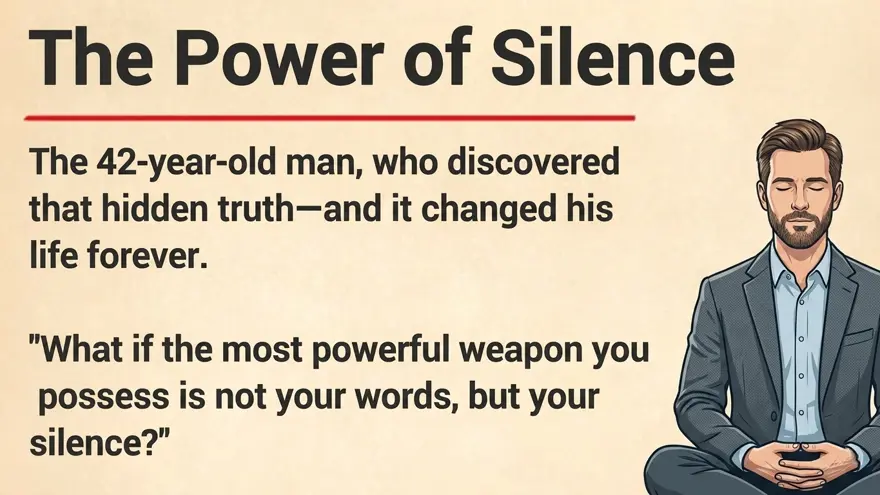
What if the most powerful weapon you possess is not your words, but your silence?
Think about it. Most people spend their entire lives defending themselves. They explain, they justify, and they beg others to understand their choices. But what if the need to explain is actually a prison? What if true power only comes when you finally stop explaining yourself?
This is the story of a man who discovered that hidden truth—and it changed his life forever.
Chapter 1: The Weight of Expectations
In a busy town called Milbrook, there lived a young teacher named David. He taught history to tenth graders at the local high school. David wasn’t just an ordinary teacher; he had a deep passion for his work, an endless well of creativity, and a genuine love for his students.
But David carried a heavy burden. He cared far too much about what other people thought.
Every single decision he made, he felt the need to explain. Every creative teaching method he tried, he justified. Every small step he took, he defended. His life had become an endless, exhausting cycle of seeking approval from people who never actually wanted to understand him.
David had been working at Milbrook High for five long years. He regularly worked twelve-hour days—carefully preparing exciting lessons, grading stacks of papers, and staying late to help struggling students. Yet, no matter how hard he worked or what he achieved, someone was always ready to criticize him.
The school principal would frown and say, “Stick to the textbook, David. Your creative methods are just confusing the students.”
His fellow teachers would whisper in the hallways, “Look at him. He thinks he’s better than us just because he uses those modern techniques.”
Even his relatives would judge him during family gatherings, asking, “Why are you still wasting your time teaching? Go get a real job that makes more money.”
And every single time, David would desperately try to explain himself. He would print out thick research papers about active learning. He would spend hours in stressful meetings defending his vision. Deep down, David was completely empty and exhausted. But he couldn’t stop. He truly believed that if he could just explain things well enough, everyone would finally understand and support him.
Slowly, David’s bright passion began to fade. To avoid the constant criticism, he stopped experimenting. He started teaching boring, safe, traditional textbook lessons. His classroom, which once buzzed with joy, energy, and curiosity, became just another silent, lifeless room.
Chapter 2: The Janitor’s Wisdom
One quiet afternoon, David sat entirely alone in the empty staff room. He was staring at his laptop screen, looking at an email he had spent a whole hour writing. It was a long, defensive letter to a parent, explaining exactly why he chose to use a group discussion instead of a standard lecture.
Just then, the old school janitor, Mr. Peterson, walked in with his broom. Mr. Peterson had worked at the school for thirty-five years. He was a quiet, wise man who had seen hundreds of young teachers come and go.
“Still here, son?” Mr. Peterson asked, noticing the deep exhaustion etched onto David’s face.
“Just finishing up some emails,” David replied, not looking up from his screen.
Mr. Peterson glanced at the laptop and let out a soft chuckle. “Another explanation letter, I see.”
David looked up, completely surprised. “How did you know?”
Mr. Peterson sat down across from him. “Because I’ve watched you do this for five years, David. You are hands down the best teacher in this building, but you are also the most tired. Do you want to know why?”
David slowly shook his head.
“Because you are wasting your life trying to convince everyone that you are doing the right thing,” the old man said gently. “But here is what thirty-five years in this school has taught me: The right people don’t need convincing. You could talk until you are blue in the face, and the wrong people will still choose to misunderstand you.”
David felt a sudden crack in his heart. “But Mr. Peterson, if I don’t explain myself, they will make my life miserable. They will think I’m wrong.”
Mr. Peterson leaned forward, his eyes sharp and kind. “Let me ask you a question, David. When did their understanding become more valuable than your peace of mind?”
David opened his mouth to speak, but no words came out. He had no answer.
“I have seen the greatest teachers this school ever had,” Mr. Peterson continued quietly. “Do you know what they all had in common? They never wasted a single second on explanations. They didn’t argue. They just did exceptional work. The students loved them, and the results proved everything. Eventually, the doubters always came around—without the teacher ever saying a single word.”
The old man stood up and picked up his broom. “Your students’ success is your only proof, David. Everything else is just noise.”
Chapter 3: The Gift of Silence
The door clicked shut, leaving David alone in the quiet room. Mr. Peterson’s words kept echoing in his mind: When did their understanding become more valuable than your peace?
That night, David sat in the dark at home, thinking about all the precious energy he had wasted over the years. How many brilliant ideas had he killed just to avoid a little criticism? For the first time in his life, something clicked deep inside him.
Maybe I don’t owe anyone an explanation, he realized. Silence isn’t weakness. Silence is self-respect.
Right then and there, David made a firm decision: “I will no longer explain myself to people who are not genuinely trying to understand me.”
The very next week, David started behaving differently.
When the principal called him in to criticize his unique teaching style, David didn’t offer a long defense. He simply nodded, looked him in the eye, and said, “I appreciate your input.”
When his colleagues made snide remarks about his modern approach in the breakroom, he didn’t argue. He just smiled calmly and said, “Let’s look at the results at the end of the year.”
When worried parents questioned his methods, he didn’t send long, desperate emails. He calmly replied, “Your child’s progress will speak for itself.”
At first, people were shocked. They pushed harder, expecting the old David to start pleading and explaining. Some people became angry; others complained even louder. But David held his ground like an anchor in a storm. He took all the energy he used to spend on defending himself and poured it entirely into his classroom.
Chapter 4: Unstoppable Results
Then, something incredible began to happen.
First, David found a deep, beautiful sense of peace. Because he stopped worrying about approval, his passion rushed back. His creativity exploded. He designed magnificent lessons that made history come alive. His classroom was suddenly filled with vibrant debates, historical role-plays, and hands-on projects that made his students truly think.
Second, his results became absolutely undeniable. By the end of the academic year, David’s students scored the highest marks in the entire school district. Children who used to hate history were now falling in love with the subject. The very parents who had complained so loudly wrote letters to thank him for changing their children’s lives.
Third, the respect he had always begged for came to him completely naturally.
The principal now used David’s creative methods as the gold standard example for the whole school. His fellow teachers started coming to him, quietly asking for his advice. The doubting relatives finally went silent. David didn’t change their minds by winning an argument. He changed their minds by making his work absolutely impossible to ignore.
One year later, David was at his desk preparing for class when Mr. Peterson walked in, holding the morning newspaper. On the front page of the local section was an article about Milbrook High winning the prestigious Best Teaching Innovation Award. David’s name and photograph were featured prominently right in the center.
“Congratulations, son,” Mr. Peterson said with a proud smile. “You finally learned the secret.”
David looked at the paper, his eyes filling with deep gratitude. “Mr. Peterson, that one question you asked me changed everything.”
The old janitor patted his shoulder. “You were never weak, David. You just gave your power away every single time you tried to justify your worth. The exact moment you stopped explaining, you became unstoppable. Lions don’t explain why they are kings. They just rule.”
Conclusion: Trust Your Path
David’s life completely transformed the moment he stopped explaining himself. He realized that he hadn’t been stuck because of difficult people; he had been stuck because he was giving those people power over his peace of mind.
Not everyone will understand your path in this life—and that is perfectly okay. People will question you. They will criticize you. They will doubt your choices.
But remember this: Your job is not to make them understand. Your job is to stay true to who you are and let your results do the talking for you.
Strong mountains don’t justify their height; they just stand tall. Powerful oceans don’t defend their depth; they just flow. You are defined by who you become when you finally stop seeking validation from the world.
Choose silence over explanation. It might just transform your entire life.
✅️ Motivation Life Lesson From This Story with life lessons:
Here are the powerful life lessons we can learn from David and Mr. Peterson’s story, written in simple, beautiful English:
1. Your Peace is More Valuable Than Their Approval
We often waste our energy trying to make everyone like us, support us, or understand us. But the truth is, you do not owe anyone an explanation for how you choose to live your life.
The Lesson: Stop letting other people’s opinions control your happiness. Protect your peace of mind—it belongs to you, not them.
2. The Right People Don’t Need Convincing
The people who truly love you, trust you, and respect you do not need a three-page explanation to stay by your side. On the flip side, the people who constantly doubt or criticize you will choose to misunderstand you no matter what you say.
The Lesson: Save your breath. You could talk until you are blue in the face, but you cannot force a closed mind to open.
3. Silence is Strength, Not Weakness
Many people think that staying silent means giving up or admitting defeat. But choosing not to argue is actually the ultimate sign of self-respect. It shows that you are so secure in who you are that you don’t feel the need to defend yourself.
The Lesson: Silence is a quiet shield. When you stop reacting to critics, you take away their power over you.
4. Let Your Results Do the Talking
Arguments do not change minds; excellence does. David didn’t win over the principal or the parents by writing long, defensive emails. He won them over because his students scored the highest marks in the district.
The Lesson: Stop talking and start doing. Work hard in the dark, and let your success make the noise for you. When your work is exceptional, it becomes impossible to ignore.
5. You Give Away Your Power When You Justify Your Choices
Every time you beg someone to understand your vision, your career choices, or your lifestyle, you are giving them the keys to your self-worth. You are letting them be the judge of your life.
The Lesson: Remember what Mr. Peterson said: “Lions don’t explain why they are kings. They just are.” Stand tall in your choices.
💡 A Final Thought for You
Strong mountains do not explain how high they are. Powerful oceans do not defend how deep they are. They just exist, beautiful and grand.
Be like the mountain. Stay true to your path, stop seeking permission from the world, and let your results speak for themselves!
✅️ Learn English From this Story:
Here is a fun and simple guide to learning English using vocabulary, expressions, and grammar patterns from David’s story!
1. Powerful Vocabulary Words
Let’s look at some great words used in the story and how you can use them in daily life:
- Exhausted(adjective): Extremely tired, both in body and mind.
- From the story: “Deep inside, David was exhausted.”
- Example: After working a 12-hour day, I was completely exhausted.
- Passion(noun): A strong feeling of excitement or love for an activity.
- From the story: “David’s bright passion began to fade.”
- Example: She has a true passion for photography and takes pictures every day.
- Criticism(noun): Remarks that point out faults, mistakes, or things that are wrong.
- From the story: “…there was always someone with criticism.”
- Example: Constructive criticism helps us improve our work.
- Defend(verb): To speak or write in support of something when it is being attacked or criticized.
- From the story: “Every step he took, he defended.”
- Example: You don’t need to defend your choices to anyone.
- Undeniable(adjective): So obviously true that no one can disagree with it.
- From the story: “Second, his results became absolutely undeniable.”
- Example: It is an undeniable fact that regular practice makes your English better.
2. Common English Idioms & Phrases
Idioms are phrases that have a special meaning different from the literal words. The story features excellent examples:
- To be blue in the face
- Meaning: To waste your energy talking or arguing for a long time without changing anything.
- From the story: “You could talk until you’re blue in the face and they still won’t get it.”
- Example: I explained the rules until I was blue in the face, but he still didn’t understand.
- Something clicked
- Meaning: To suddenly understand something clearly or realize a solution.
- From the story: “For the first time, something clicked.”
- Example: I struggled with English grammar for months, but yesterday, something clicked.
- To hold your ground
- Meaning: To refuse to change your mind, position, or opinion when people pressure you.
- From the story: “But David held his ground like an anchor in a storm.”
- Example: Even though everyone disagreed with her, she held her ground.
- In the dark
- Meaning: To do something quietly, out of sight, or without others knowing.
- From the lesson: “Work hard in the dark, and let your success make the noise.”
3. Useful English Structures (Grammar Patterns)
A. The “Far Too Much” Pattern
We use this structure to show that an action or feeling is excessive and causing a problem.
- Story Sentence: “David cared far too much about what other people thought.”
- How to use it:
Subject + verb + far too much + noun/phrase- Example 1: He drinks far too much coffee in the morning.
- Example 2: You worry far too much about making mistakes when speaking English.
B. The “Every Single Time” Pattern
This is used to emphasize that something happens repeatedly without fail.
- Story Sentence: “And every single time, David would explain himself.”
- How to use it:
Every single time + [Condition], + [Action]- Example 1: Every single time it rains, the roof leaks.
- Example 2: Every single time I practice speaking out loud, I feel more confident.
C. The “The More… The More…” Pattern
This pattern connects two changes together. When one thing changes, the other changes too.
- From the story context: The more David explained himself, the more tired he became.
- How to use it:
The [comparative adjective], the [comparative adjective]- Example 1: The more you practice English, the easier it becomes.
- Example 2: The quieter you are, the more you can hear.
4. Speaking Practice: Say it Out Loud!
Try reading these powerful sentences from the story aloud to practice your English rhythm and pronunciation:
“Lions don’t explain why they are kings. They just are.”
“Silence isn’t weakness. Silence is self-respect.”
“The right people don’t need convincing.”
📝 Conclusion
Copy and paste this text at the very end of your post to drive comments and social shares:
Final Thoughts: Let Your Success Make the Noise
David’s life completely transformed the exact moment he stopped seeking validation from his critics. He realized a profound truth that we should all carry with us: he wasn’t stuck because of difficult people; he was stuck because he gave those people power over his inner peace.
In this life, not everyone is going to understand your vision, your timing, or your path—and that is completely fine. Your responsibility isn’t to force them to understand. Your responsibility is to stay true to your values, stand tall, and let your exceptional results do the talking for you.
Remember what the wise janitor told David: “Lions don’t explain why they are kings. They just are.” Strong mountains don’t justify their height to the valleys below, and powerful oceans don’t defend their depth. They just exist perfectly as they are.
💬 Over to You: What was the biggest lesson you took away from David and Mr. Peterson’s story today? Are you ready to stop explaining your choices to people who choose to misunderstand you? Leave a comment below and type “I choose silence” if you are ready to protect your peace!
Don’t forget to bookmark our blog and share this story with a friend who needs this exact message today!



 Life Quotes3 years ago
365 Depression Quotes and Sayings About Depression (Extremely Amazing)
- Inspirational Quotes3 years ago
342 Motivational & Inspirational Quotes
- Inspirational Quotes3 years ago
580 Motivational & Inspirational Quotes Life To Succeed
- Motivational Quotes3 years ago
600 Inspirational & Motivational Quotes About Life to Succeed
- Good Morning Quotes3 years ago
100 Beautiful Good Morning Quotes with Images That Will Enrich Your Day
- Sad Love Quotes3 years ago
110 Sad Life Quotes – Sad Quotes & Sayings About Sadness
- Sad Messages3 years ago
Top 70 Broken Heart Quotes And Heartbroken Sayings
- Inspirational Quotes3 years ago
97 Inspirational Quotes That Will Change Your Life