English Graded Reader
Stop Trying to Look Successful. (Do This Instead) | English Graded Reader
In today’s fast-paced world, we are often told that “image is everything.” We spend hours polishing our social media profiles, buying the latest gadgets, and trying to look as successful as possible. But what happens when life gets difficult?
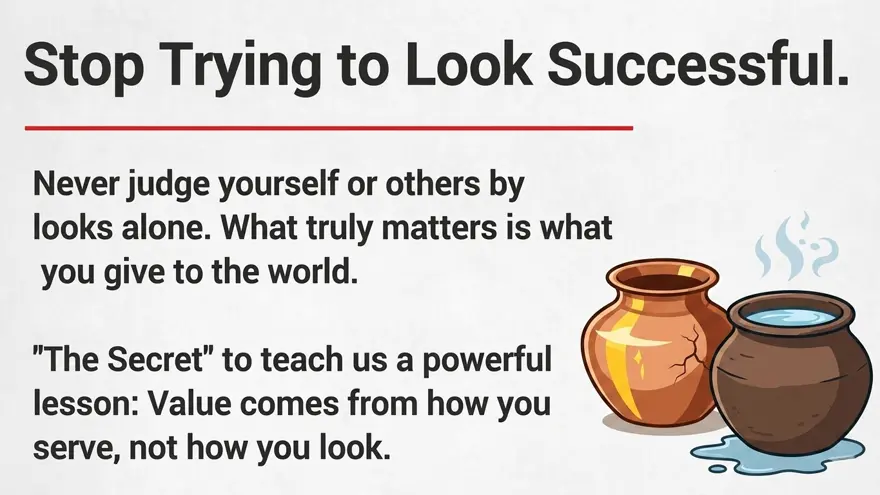
In this English Graded Reader story, we explore the powerful lesson of the Copper and the Clay Pot. While one vessel shines like gold, the other is humble and plain. However, a harsh summer soon reveals a “secret” truth: your true worth isn’t found in your outer shine, but in your ability to help others.
If you are looking to improve your English listening and reading skills while gaining deep motivation for your life, this story is for you. Let’s discover why being useful is far more powerful than just being beautiful.
The Gift of the Earth and the Curse of Gold
Act I: The Mirror of the Sun
At the dusty crossroads where the bustling trade winds met a quiet, forgotten village, two vessels sat on a wooden bench. They were neighbors, sharing the same small patch of shade beneath an old banyan tree, yet they belonged to entirely different worlds.
The first was a copper pot, a masterpiece of the blacksmith’s forge. It was polished to such a high mirror finish that it seemed to trap the sunlight within its body. When the sun rose, the copper pot blazed like pure gold, casting dazzling beams of light across the dirt road.
The second was a clay pot, shaped by the calloused hands of a local potter. It was dark, rough-textured, and entirely plain. It bore no patterns, no polish, and no grandeur. It simply smelled faintly of rain and ancient earth.
Every morning, as the dew melted away, the copper pot would peer into a nearby puddle to admire its own glittering reflection.
“Look at the way the light dances across my shoulders,” the copper pot would boast, its voice ringing out with a sharp, metallic chime. “I am a treasure fit for a palace. People will look at me and see royalty. But you? You are nothing but mud and ash. Dull, dark, and ugly. You do not even deserve to sit on the same bench as me.”
The clay pot remained perfectly still. It did not tremble with anger, nor did it hide in shame. It simply smiled, its voice low and grounding, like the rustle of dry leaves.
“Everyone has their own purpose in this world, my friend,” the clay pot replied softly. “Pride is a heavy burden to carry, and it does not last forever.”
The copper pot threw its head back and laughed, a mocking, echoing sound. “Purpose? Don’t fool yourself. In a world driven by desire, appearance is everything. Beauty is the only purpose that matters.”
Act II: The Whisper of the Travelers
Weeks bled into months. The road was never empty; a steady stream of merchants, farmers, and weary travelers marched past the banyan tree.
Almost every passerby would stop and gasp at the brilliant shine of the copper pot. They would point at it, admire their own reflections in its metal skin, and marvel at its craftsmanship. Yet, strangely, when their long journeys left them breathless and weary, they would bypass the shiny vessel entirely. Instead, they would tilt the humble clay pot, pouring its contents into their hands to drink.
This deeply frustrated the copper pot. Day after day, it received all the praise, yet the clay pot received all the touch.
One quiet afternoon, unable to contain its anger, the copper pot snapped, “Why do they keep choosing you? Are they blind? Can they not see the dust on your skin and the glory of my frame?”
The clay pot looked out at the shimmering heat waves on the horizon and replied gently, “They do not come to the crossroads to look at a mirror. They come to quench a fire inside them. They do not seek beauty; they seek life.”
The copper pot scoffed, turning its face away, refusing to let go of its arrogance.
Act III: The Furnace of Summer
Then, the great summer arrived.
It was a season of merciless, blinding heat. The clouds vanished from the sky, leaving a sun that burned like an open furnace. The green fields turned to yellow dust, the ground cracked open like broken glass, and the very air felt like breathing fire.
In this cruel heat, the copper pot’s greatest pride became its terrible undoing. Because it was made of metal, it absorbed the sun’s rays greedily. Hour by hour, it grew hotter and hotter. Soon, its beautifully polished skin was scalding to the touch. The water trapped inside its belly began to warm, then simmer, until it became a hot, stagnant vapor—completely undrinkable.
Meanwhile, the clay pot sat quietly in the shade. Its porous walls breathed, allowing tiny microscopic beads of moisture to evaporate from its surface, naturally cooling the water hidden deep within its core.
Through the haze of the heat, a lone traveler appeared on the road. He was a poor woodcutter, his clothes torn, his lips cracked and bleeding from dehydration. He staggered toward the wooden bench, his eyes wide with desperation.
He saw the magnificent copper pot first, gleaming like a mirage. “Ah, a vessel fit for a king!” he gasped, throwing himself forward. “Surely, the water inside must be sweet and pure!”
With trembling hands, he reached out and grabbed the copper handle.
“Ahhh!” the traveler screamed, instantly pulling his hands away. The blistering metal had scorched his palms. “It’s a trap! It is filled with fire!”
Panting, cradling his burned hands, the traveler looked down in despair. Then, his eyes fell upon the dark, unpretentious clay pot. Desperate, he carefully touched its rim. It was wonderfully, shockingly cool.
He lifted the clay pot to his cracked lips and tipped it forward. A stream of water—as cold and refreshing as a mountain spring—rushed down his throat. The traveler closed his eyes, a look of profound relief washing over his face.
“Blessed be this earth,” he whispered, resting his forehead against the cool clay. “This is the water of life.”
Act IV: The Awakening
Before long, a crowd of travelers gathered under the banyan tree, all escaping the brutal sun. Not a single person looked at the shining copper pot. In fact, they pushed it aside to make room. They gathered in a circle around the clay pot, passing it from hand to hand, drinking deeply, and sighing with pure satisfaction.
The clay pot stood silently, emptying itself completely to satisfy the needs of strangers, asking for nothing in return.
The copper pot watched this scene unfold in absolute silence. For the first time since the blacksmith had hammered it into shape, it felt a sensation it had never known. It was not pride. It was not anger. It was a deep, aching shame.
It looked down at its own brilliant, golden surface, now warped by the heat waves, and whispered to itself, “What is the use of my beauty? What is the worth of my golden shine, if I cannot comfort a single suffering soul?”
The crowd eventually moved on, leaving the two vessels alone once more in the fading evening light.
The copper pot turned toward its neighbor. The arrogance was entirely gone from its voice, replaced by a soft, trembling humility.
“I was blind,” the copper pot whispered. “I thought because I was beautiful, I was superior. But today I see the truth. You are cracked, you are plain, and you are made of common mud—yet you are far more valuable than I could ever hope to be.”
The clay pot smiled, the evening breeze humming gently across its rim.
“Value is never born from how we look, my friend,” the clay pot said, its voice filled with timeless wisdom. “True value is born from how we serve. In this journey of life, outer beauty may capture the eyes for a moment, but it is inner goodness that rescues the heart. Pride and appearance will always fade like the setting sun, but the grace of helping others leaves a mark that lasts forever.”
The Moral
Never measure your worth, or the worth of those around you, by the armor you wear or the shine of your exterior. The world is full of beautiful things that offer no comfort. What truly matters is the depth of your character and what you give to those in need. In the end, it is not your shine, but your kindness that defines your legacy.
✅️ Motivation Life Lesson From This Story:
This story is a powerful reminder that our worth isn’t found in our “packaging,” but in our “product.” Here are the key motivational life lessons broken down into simple English:
1. Utility Over Vanity
In the real world, being useful is better than being decorative. The copper pot was beautiful to look at, but it failed at its only job: providing water.
- The Lesson: Focus on developing skills and character that actually help people. A flashy title or a fancy outfit doesn’t matter if you can’t provide value when things get tough.
2. Inner Peace is Stronger than Outer Pride
The clay pot didn’t get angry when it was insulted. It stayed calm because it knew its own value.
- The Lesson: When you know who you are and what you contribute, the insults of others won’t bother you. Real confidence is quiet; it doesn’t need to shout like the copper pot.
3. The “Heat” Reveals Your True Character
Everything looks good when life is easy (springtime). But when the “heat” of life arrives—stress, crisis, or hard times—your true nature comes out.
- The Lesson: Hard times act as a filter. They expose people who are “all talk” (the hot copper) and highlight those who are reliable and “cool” under pressure (the clay).
4. Humility is an Asset, Not a Weakness
The clay pot’s humble material allowed it to keep the water cool. Its “plainness” was actually its greatest strength.
- The Lesson: Don’t be ashamed of your humble beginnings or your simple lifestyle. Often, the very things you think are “plain” about yourself are the tools that allow you to serve others best.
5. Kindness is the Only “Shine” That Lasts
At the end of the story, the copper pot realized that its beauty was useless because it couldn’t offer comfort.
- The Lesson: People may admire you for your success or looks, but they will love you for your kindness. No one remembers how the copper pot looked; they only remembered how the clay pot saved them.
The Big Takeaway: Don’t spend all your time polishing your “shine” (your image). Spend your time filling your “vessel” (your heart) with something that can quench the world’s thirst. Be the clay pot in a world full of copper.
✅️ Learn English From this Story:
This story is a goldmine for learning vocabulary, idioms, and sentence structures. Because the story uses a lot of contrast (comparing the copper pot and the clay pot), it is a great way to learn descriptive English.
Here is a breakdown of the language skills you can learn from this fable:
1. Powerful Vocabulary (Word Bank)
Instead of using basic words like “hot” or “pretty,” the story uses advanced, descriptive words.
| Basic Word | Story Word | Meaning | Example from Story |
|---|---|---|---|
| Container | Vessel | A hollow container for liquids. | “…two vessels sat on a wooden bench.” |
| Thirsty | Parched | Extremely dry; desperately in need of water. | “…his throat parched and desperate for a drink.” |
| Hot | Scalding | So hot that it can burn or blister your skin. | “…its beautifully polished skin was scalding to the touch.” |
| Satisfy | Quench | To stop your thirst by drinking a liquid. | “…they come to quench a fire inside them.” |
| Plain/Ugly | Unpretentious | Simple, humble, not trying to look fancy. | “…then his eyes fell upon the dark, unpretentious clay pot.” |
2. Idioms & Metaphors (Figurative Language)
Fables often use figurative language to give deep meaning to simple things.
- “All talk” (Metaphor: The Copper Pot)
- What it means: Someone who looks impressive or talks big, but does nothing useful when a real crisis happens.
- How to use it: “The new manager is like the copper pot—he looks fancy, but he does no real work.”
- “Cool under pressure” (Metaphor: The Clay Pot)
- What it means: Staying calm, helpful, and relaxed even when a situation is highly stressful (or hot).
- How to use it: “She stayed as cool as a clay pot during the difficult exam.”
- “To wrap oneself in pride”
- What it means: To become so arrogant that you refuse to see reality or listen to advice.
- How to use it: “He wrapped himself in his pride and refused to apologize.”
3. Grammar Spotlight: Contrasting with “While” and “Instead”
To show the difference between two things happening at the same time, the story uses connectors like while, instead, and meanwhile. This is an essential skill for intermediate English learners.
- Using “Instead”:
- Story: “…they would bypass the shiny vessel entirely. Instead, they would tilt the humble clay pot…”
- Grammar Tip: Use “instead” when you reject one option and choose another.
- Using “Meanwhile”:
- Story: “The copper pot… grew hotter and hotter. Meanwhile, the clay pot sat quietly in the shade.”
- Grammar Tip: Use “meanwhile” to show two different actions happening at the exact same time in different places.
4. Speaking & Pronunciation Practice
If you are reading this story aloud, look at these phrases that use adverbs to show how a character is speaking. Practicing these will help you sound more natural and emotional:
- “Boastfully” / “With a sharp chime”: Say the copper pot’s lines with a high, proud, energetic voice.
- “Softly” / “Gently”: Say the clay pot’s lines with a low, calm, slow voice.
- “Whispered with trembling humility”: Say the copper pot’s apology at the end with a quiet, shaky voice to show regret.
Try it yourself: Pick three words from the Word Bank above and write your own simple sentences with them in the reply below. I will gladly check your grammar!
Frequently Asked Questions (FAQ)
What is the main lesson of the “Copper and Clay Pot” story?
The core lesson is that true value is found in your purpose and how you serve others, not in your outward appearance. While the copper pot’s beauty was temporary and failed under pressure, the humble clay pot’s inner goodness allowed it to provide refreshment to those in need.
Why is this story considered a “Graded Reader”?
This content is designed as a Graded Reader because it uses simple, immersive English specifically optimized for learners to practice reading and listening. It focuses on clear vocabulary and storytelling structures to help improve language acquisition.
What is the “Clay Pot Secret” mentioned in the video?
The “secret” is the realization that being useful is far more powerful than being beautiful. It suggests that when life gets difficult (the “harsh summer”), people look for substance and kindness rather than just a shiny exterior.
How can this story help me improve my English?
By engaging with this story, you can:
- Expand your vocabulary with descriptive words like parched, scalding, and unpretentious.
- Practice listening through dramatic audio narration cues.
- Understand metaphors, such as comparing “shine” to image and “water” to service.
Who is the intended audience for this content?
This content is perfect for English learners (typically Level B1-B2), people seeking daily motivation, and anyone interested in self-improvement and building genuine character.
Conclusion
The story of the two vessels reminds us that pride and appearance are temporary, but the value of kindness lasts forever. As we learned from the humble clay pot, people may admire beauty, but they will always return to those who can quench their thirst and offer real comfort.
Your Takeaway:
- Stop chasing the “shine” of looking perfect.
- Start building the “substance” of inner goodness and service.
- Remember the Secret: Value comes from how you serve, not how you look.
Never judge yourself or others by looks alone. What truly matters is what you give to the world. Because in the end, it is not your shine, but your kindness that defines your worth.
Did this story change how you think about success? Let me know in the comments below!



 Life Quotes3 years ago
365 Depression Quotes and Sayings About Depression (Extremely Amazing)
- Inspirational Quotes3 years ago
342 Motivational & Inspirational Quotes
- Inspirational Quotes3 years ago
580 Motivational & Inspirational Quotes Life To Succeed
- Motivational Quotes3 years ago
600 Inspirational & Motivational Quotes About Life to Succeed
- Good Morning Quotes3 years ago
100 Beautiful Good Morning Quotes with Images That Will Enrich Your Day
- Sad Love Quotes3 years ago
110 Sad Life Quotes – Sad Quotes & Sayings About Sadness
- Sad Messages3 years ago
Top 70 Broken Heart Quotes And Heartbroken Sayings
- Inspirational Quotes3 years ago
97 Inspirational Quotes That Will Change Your Life