English Graded Reader
Doing These 10 Things Alone Will Change Your Life | English Graded Reader
There comes a quiet, heavy moment in every life when you look around and realize a difficult truth: nobody is coming to rescue you.
No cinematic music is going to play in the background, no perfect opportunity is going to land directly in your lap, and no magical event is going to suddenly make the chaos of the world make sense. The noise of the crowd eventually fades away, leaving just you, standing face-to-face with the very challenges you have spent years trying to run from.
The uncomfortable truth is that some of the most defining lessons in life cannot be taught in a crowded room; they can only be learned in exile. They can only be mastered alone. While these paths are forged in deep discomfort, they ultimately shape you into someone stronger than you ever imagined possible.
In this intermediate-to-advanced English Graded Reader, we follow the journey of a young man named Stephen, who packed a single bag to walk away from his comfort zone. Through his experiences, you will explore the 10 brutal, beautiful things everyone must learn to do on their own—all while building your English vocabulary, mastering complex past-tense structures, and sharpening your listening comprehension.
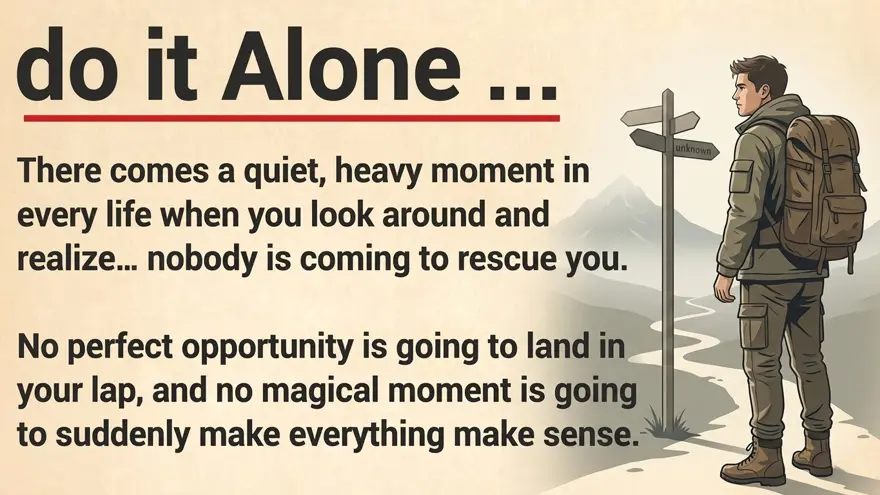
The Audacity to Stand Alone
There comes a quiet, heavy moment in every life when the illusions finally fade. You look around, and the realization hits you: nobody is coming to rescue you.
There is no cinematic cinematic soundtrack about to swell in the background. No perfect opportunity is going to land in your lap, and no magical event is going to suddenly make the chaos of the world make sense. The music has stopped. It is just you, standing entirely on your own, face-to-face with the very challenges you have spent months or years trying to run from.
The uncomfortable truth is that the most defining lessons in life cannot be taught in a crowded room. They can only be learned in exile. They can only be learned alone. And while these lessons are forged in discomfort, they shape you into someone stronger than you ever imagined possible.
If you want to truly own your destiny, here are the 10 brutal, beautiful things you must learn to do entirely on your own.
1. Master the Silence of Your Own Company
Most people are terrified of their own minds. They fill every empty second with artificial noise—scrolling through social media, blasting music, playing videos, or sending meaningless messages. They do anything to avoid being trapped in a room with their own thoughts. But true power begins when you turn off the noise. When you can sit quietly in an empty room and genuinely enjoy your own company, you break free. You stop depending on the outside world to distract you from yourself.
2. Suffer and Rebuild in Absolute Silence
Not every battle needs an audience. We live in a world where people rush to post their heartbreaks and setbacks online, begging for validation. But when life knocks you down—when you fail, when your confidence shatters, when your plans turn to ash—that is your sacred ground. Your real character isn’t built when the crowd is cheering for you. It is built in the shadows, when nobody even knows you are struggling, and you choose to stand back up anyway.
3. Walk into the World Unaccompanied
There is a unique bravery in doing things alone. Go to a restaurant and ask for a table for one. Sit in a movie theater by yourself. Take a long walk through a crowded city without a companion. These small acts teach you independence. The more comfortable you become moving through the world in your own presence, the less you will ever crave or need the approval of others. You become your own anchor.
4. Step into the Dark Without a Guarantee
Life does not hand out maps. At some point, you will reach a crossroads where you must choose a direction, even though you cannot see where the path leads. Many people paralyze themselves waiting for absolute certainty, but waiting for a guarantee means staying stuck forever. Growth does not happen in safety. It happens when you take a deep breath and step forward into the unknown, trusting yourself to handle whatever you find there.
5. Cut the Cords of the Past
Not everyone who walks into your life is meant to walk with you to the end. Some people are only meant to be a chapter, not the whole book. When relationships become toxic, one-sided, or heavy weights that drag you down, you must learn to let them go. Walking away from people you once loved is deeply painful. But sometimes, walking away is the ultimate act of self-respect.
“The turning point of your life begins the moment you stop looking for a savior in the crowd, and realize the only person who can save you is looking back at you in the mirror.”
6. Look in the Mirror and Admit Your Weaknesses
It is incredibly easy to blame your problems on bad luck, unfair circumstances, or other people. It is much harder to look at your life and admit that you are the one holding yourself back. Real transformation doesn’t start with self-praise; it starts with brutal honesty. The moment you stop making excuses for your bad habits and start taking ownership of your flaws is the exact moment you gain the power to change them.
7. Gather the Ashes and Begin Again
Rebuilding your life from scratch is terrifying. When everything falls apart, you lose your comfort, your routine, and your sense of security. It feels like death. But look at history: every great person has had a moment where they lost everything and had to rebuild from the ground up. Do not fear the collapse. A new, grander chapter of your life can only begin where the old one completely ends.
8. Disconnect from the Matrix
We live in a world designed to steal your attention. Notifications buzz, messages pop up, and an endless stream of content fights for every micro-second of your focus. It is easy to lose your soul to the screen. Learning to intentionally disconnect—to unplug the phone, step away from the digital noise, and look at the real world—reminds you of a vital truth: your human worth is not measured by how many people are noticing you online.
9. Accept the Gift of Being Misunderstood
No matter how kind, intelligent, or well-meaning you are, some people will simply not like you. They will criticize your choices, misinterpret your words, and judge your life. Trying to win over every critic is a war you will never win. True, unbreakable peace only arrives when you finally stop living your life to please other people’s opinions. Let them misunderstand you. Your life is not their business.
10. Take Absolute Ownership of Your Future
Your past has shaped you, but it does not have the power to dictate your future. The mistakes you made yesterday, the opportunities you watched slip through your fingers, and the trauma you have endured do not get to decide the rest of your story. The exact second you say, “This is my responsibility,” you take your power back. You cannot change yesterday, but you hold the pen that will write tomorrow.
The Verdict
The strongest people on this planet are not those who have lived a life free of pain and discomfort. They are the ones who felt the weight of the world, faced it alone in the dark, learned from it, and kept moving forward anyway.
Take a deep breath. The rescue party isn’t coming. Save yourself.
The Story: do it Alone…
Once upon a time, in a quiet town nestled between rolling hills, lived a young man named Stephen. To everyone else, Stephen’s life looked completely fine. But inside, he felt like he was drifting at sea. He was constantly waiting—waiting for a lucky break, waiting for someone to fix his problems, waiting for a sign.
One evening, while staring at his reflection in a rain-splattered window, a heavy realization hit him. Nobody was coming to rescue him. There would be no magical moment where his life suddenly sorted itself out. It was just him, standing face-to-face with his own fears.
To find himself, Stephen packed a single bag and walked away from his comfortable life. This is the story of his journey through the 10 truths of standing alone.
1. Master the Silence of Your Own Company
When Stephen first arrived at a small, isolated cabin in the woods, the silence was deafening. For the first few days, his hand constantly twitched for his phone. He wanted to scroll through social media, play loud music, or call someone—anything to escape the quiet. But by the second week, something shifted. He learned to sit on the porch with a cup of tea, watching the sunset, perfectly content. He no longer needed noise to feel alive; he had mastered the art of being alone without being lonely.
2. Suffer and Rebuild in Absolute Silence
One month into his journey, a severe storm hit the valley. The roof of Stephen’s cabin leaked, his firewood soaked through, and he spent three days cold, wet, and shivering in the dark. His old instinct was to complain online or call a friend for pity. Instead, he kept his struggle to himself. When the sun finally came out, he quietly went to work, fixing the roof and chopping new wood. In that quiet struggle, without anyone watching or cheering him on, Stephen discovered a deep, inner resilience he never knew he had.
3. Walk into the World Unaccompanied
Once his cabin was repaired, Stephen decided to visit the nearest bustling city. Walking into a crowded, popular restaurant, he asked the host for a “table for one.” At first, he felt self-conscious, imagining everyone was judging him. But as he ate his meal and watched the world go by, a wave of freedom washed over him. He went to a movie theater alone, and then took a long walk through the city park. He realized he didn’t need a companion to enjoy the beauty of the world.
4. Step into the Dark Without a Guarantee
Leaving the city, Stephen reached a fork in the road. One path led back to his old, predictable town. The other path wound high up into a misty, unfamiliar mountain. There were no signs, no maps, and no guarantees of what lay ahead. His hands shook with anxiety. But Stephen knew that staying stuck in comfort was worse than facing the unknown. He took a deep breath, turned away from his old life, and stepped onto the misty mountain path.
5. Cut the Cords of the Past
While walking that high path, Stephen had a lot of time to think about his relationships. He remembered a friend from back home who constantly put him down, drained his energy, and held him back from his dreams. Stephen had held onto the friendship out of habit. Standing on the mountain peak, looking at the vast horizon, he finally let go of the guilt. He mentally wished the old friend well, cut the emotional cord, and decided he would only carry uplifting relationships into his future.
6. Look in the Mirror and Admit Your Weaknesses
One afternoon, Stephen got completely lost. He sat down on a rock, frustrated, and immediately began blaming the confusing mountain trails and the bad weather. But then, he stopped. He looked at his reflection in his water canteen. The truth was, he hadn’t prepared properly. He hadn’t studied the terrain. He admitted his own laziness to himself. The moment he stopped making excuses and took ownership of his mistake, he was able to think clearly, find his bearings, and get back on track.
7. Gather the Ashes and Begin Again
Disaster struck on the third month of his journey. A sudden camp accident caused a small fire that destroyed Stephen’s tent, his map, and most of his supplies. He was left with almost nothing. Sitting among the literal ashes of his gear, he wanted to cry and give up. But instead, he took a deep breath. He gathered what scraps were left, built a temporary shelter from branches, and began again. He realized that a collapse isn’t the end of the story—it’s just where the new chapter begins.
8. Disconnect from the Matrix
Eventually, Stephen returned to civilization and visited a local café. Everywhere he looked, people were glued to their screens, modern captives to notifications, likes, and endless digital noise. Stephen looked down at his own phone, which had finally regained a signal. It was buzzing like crazy. Smiling quietly, he turned the device completely off and slipped it into his bag. He chose to look out the window at the real, breathing world, knowing his worth wasn’t tied to a digital screen.
9. Accept the Gift of Being Misunderstood
When Stephen briefly reconnected with a few people from his past, they laughed at his journey. They called him foolish, strange, and told him he was wasting his time. In the past, their criticism would have crushed him. But Stephen just smiled gently. He accepted that they lived in a different world and would never understand his path. He didn’t argue or try to win their approval. He simply walked away, wrapped in the beautiful peace of not caring what others thought.
10. Take Absolute Ownership of Your Future
On the final day of his year-long journey, Stephen stood on a high cliff overlooking the ocean. He thought about his past mistakes, the years he wasted waiting for a savior, and the hardships he had faced. None of it mattered anymore. Those things did not define him. He knew that while he couldn’t change where he came from, he was the sole author of where he was going. He took absolute responsibility for his life.
The Verdict
Stephen returned to the world a completely transformed man. He wasn’t louder or grander, but he carried an unbreakable quiet strength. He had faced the discomfort of the wild, learned its brutal lessons, and kept moving forward.
He no longer looked at the horizon waiting for a rescue party. He looked in the mirror, smiled, and knew that he had already saved himself.
✅️ Learn English From this Story:
Let’s break down the advanced vocabulary, idioms, and unique phrases used in Stephen’s journey to help you improve your English fluency.
📚 English Lesson: Vocabulary & Expressions from the Story
1. Key Vocabulary Words
- Nestled (verb): Settled comfortably or hidden partially inside something.
- From the story: “In a quiet town nestled between rolling hills…”
- How to use it: “The small cottage was nestled among the trees.”
- Deafening (adj): Extremely loud. Interestingly, we also use it to describe a silence that feels heavy or uncomfortable.
- From the story: “…the silence was deafening.”
- How to use it: “The crowd made a deafening noise when the goal was scored.”
- Resilience (noun): The capacity to recover quickly from difficulties; toughness.
- From the story: “…Stephen discovered a deep, inner resilience.”
- How to use it: “Her resilience helped her get through a very difficult year at work.”
- Bearings (noun): Awareness of one’s position or direction.
- From the story: “…think clearly, find his bearings, and get back on track.”
- How to use it: “Without a map, it took me a few minutes to find my bearings in the new city.”
2. Idioms & Phrasal Verbs
- Drifting at sea: An idiom meaning to feel lost, aimless, or without direction in life.
- From the story: “…inside, he felt like he was drifting at sea.”
- Knocks you down: A phrasal verb meaning to defeat, overwhelm, or cause someone to fail.
- From the story: “When life knocks you down—that is your sacred ground.”
- Cut the cords: An idiomatic expression meaning to break an emotional or physical attachment to someone or something from the past.
- From the story: “…he finally let go of the guilt. He mentally cut the emotional cord…”
- Glued to their screens: A very common modern idiom meaning to look at a phone or computer completely fascinated, without looking away.
- From the story: “…everywhere he looked, people were glued to their screens…”
🛠️ Grammar Spotlight: “Used to” vs. “Would” for Past Habits
In the story, we look at how Stephen changed over time. To talk about his past habits, we can use two different structures.
The Rule:
- Used to: Used for past states, situations, or habits that are no longer true today.
- Would: Used only for repeated action verbs in the past (not for states or feelings).
Examples from Stephen’s Journey:
- State (Use Used to): “Stephen used to feel lost every single day.” (You cannot say: “Stephen would feel lost” for a permanent state).
- Action (Use Would or Used to): “In the past, their criticism would crush him.” or “Their criticism used to crush him.”
🗣️ Pronunciation & Fluency Practice
To sound more like a native speaker, focus on Word Stress and Connected Speech (linking words together). Try reading these sentences out loud:
- The Glottal Stop & Linking:“Nobody is coming to rescue you.”
- Fluency Tip: Blend “rescue” and “you” together so it sounds like “res-cue-ya”.
- Contractions for Rhythm:“A collapse isn’t the end of the story—it’s just where the new chapter begins.”
- Fluency Tip: Emphasize the words collapse, end, new, and begins to create a natural English rhythm.
✍️ Practice Challenge for You!
Can you practice your English right now? Choose one new vocabulary word or idiom from above (like resilience or find your bearings) and write your own sentence in the comments below! I will check your grammar.
💬 Frequently Asked Questions (FAQ)
1. What is an English Graded Reader story? An English Graded Reader is a story written or adapted specifically for language learners. It uses structured grammar and carefully selected vocabulary levels so that you can improve your fluency naturally through immersive reading or listening practice, without constantly needing a dictionary.
2. How can I use this story to improve my English speaking skills? The best method is called shadowing. Listen to a sentence from Stephen’s story, pause the audio, and try to repeat it aloud exactly like the narrator. Focus on matching the emotional tone, word connections, and pronunciation to build natural speaking muscle memory.
3. What English proficiency level is this story best suited for? This story is optimized for Intermediate (B1-B2) to Advanced (C1) learners. It uses simple sentence structures to remain highly readable, but introduces advanced vocabulary words (like resilience and bearings) and deep emotional metaphors to challenge your comprehension.
4. Why is the theme focused on “standing alone” and “self-rescue”? True personal growth and language fluency both require deep, independent discipline. The story uses Stephen’s physical journey through the wild as a powerful metaphor for the mental battles we all face when learning to trust our own capabilities, make decisions without guarantees, and take ownership of our future.
5. How do I practice using the new vocabulary from Stephen’s journey? Don’t just memorize the list! Choose three new words or idioms from the lesson—such as find your bearings or cut the cords—and write your own personal sentences using them in the comments section below. I will personally review them and check your grammar!
Conclusion
The Verdict: Your Story Is Yours to Write
Stephen returned to the world a completely transformed man. He wasn’t louder, and he didn’t boast about his victories, but he carried an unbreakable, quiet strength deep within his soul. He had faced the terrifying discomfort of the wild, learned its brutal lessons in absolute silence, and kept moving forward anyway.
He no longer stared at the horizon, waiting for a savior or a lucky break. He simply looked in the mirror, smiled, and knew that he had already saved himself.
The strongest people on this planet are not those who avoid hard times, conflict, or loneliness. They are the ones who face the darkness entirely on their own, gather the literal ashes of their past, and rebuild themselves from scratch. You cannot alter where you came from yesterday, but you hold the pen that writes your tomorrow.
“The rescue party isn’t coming. Take absolute ownership. Save yourself.”
💬 Frequently Asked Questions (FAQ)
1. What is an English Graded Reader?
An English Graded Reader is a story adapted specifically for language learners. It uses carefully chosen language, structure, and targeted vocabulary levels to help readers improve fluency naturally through engaging contexts.
2. How does motivational storytelling improve language acquisition?
When you engage emotionally with a narrative—like Stephen’s journey of independence—your brain retains vocabulary and complex grammatical structures (such as the difference between “used to” and “would”) far more effectively than memorizing list formulas.

 Life Quotes3 years ago
365 Depression Quotes and Sayings About Depression (Extremely Amazing)
- Inspirational Quotes3 years ago
342 Motivational & Inspirational Quotes
- Inspirational Quotes3 years ago
580 Motivational & Inspirational Quotes Life To Succeed
- Motivational Quotes3 years ago
600 Inspirational & Motivational Quotes About Life to Succeed
- Good Morning Quotes3 years ago
100 Beautiful Good Morning Quotes with Images That Will Enrich Your Day
- Sad Love Quotes3 years ago
110 Sad Life Quotes – Sad Quotes & Sayings About Sadness
- Sad Messages3 years ago
Top 70 Broken Heart Quotes And Heartbroken Sayings
- Inspirational Quotes3 years ago
97 Inspirational Quotes That Will Change Your Life