Learn English
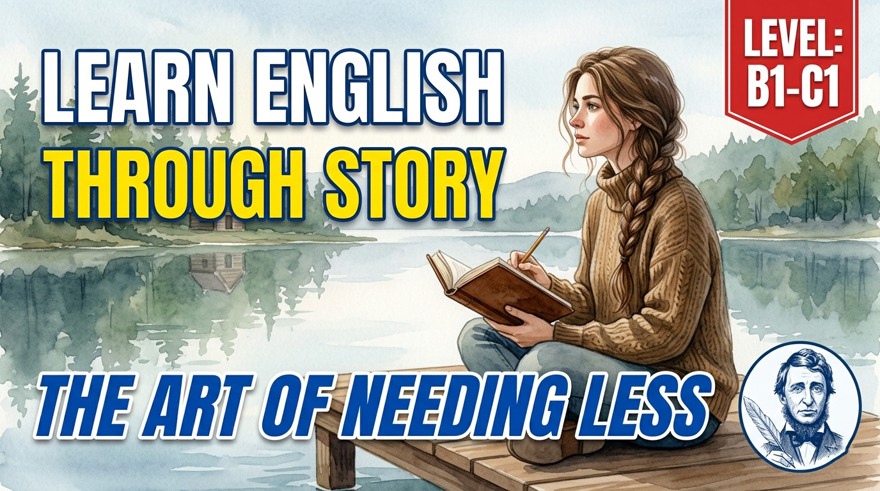
The Art of Needing Less | Learn English Through Story (Level: B1-C1) – Thoreau’s Secret
Have you ever felt that the more things you own, the less freedom you actually have? In a world that constantly tells us to “want more,” the true secret to happiness might actually be the Art of Needing Less.
In this lesson, Learn English Through Story (Level: B1-C1), we dive into the life and philosophy of Henry David Thoreau. In 1845, Thoreau conducted a famous experiment: he moved into a tiny cabin in the woods to see if he could find clarity by stripping away the noise of modern life.
Whether you are looking to improve your English vocabulary or find a blueprint for a simpler, more meaningful life, this story provides the perfect bridge between language learning and deep personal growth.
True Motivation
True motivation doesn’t come from chasing a bigger paycheck or a faster car; it comes from reclaiming your time. Thoreau’s experiment proves that when you stop trying to impress others and start simplifying your life, you find the mental “clarity” needed to discover who you actually are.
The Art of Needing Less: Thoreau’s Blueprint
Once, there was a man named Henry David Thoreau. He lived in a time when people were becoming very busy. Factories were growing, and everyone wanted to buy more things. Henry felt that people were losing their souls in the rush.
He asked himself a simple question: “How much do I really need to be happy?”
To find the answer, he went into the woods near Walden Pond. He didn’t buy a big house; instead, he built a tiny cabin with his own hands. He spent only $28.12 on materials. He didn’t have a soft sofa or a fancy kitchen. He had a bed, a table, and three chairs.
“I had three chairs in my house,” Henry said. “One for solitude, two for friendship, and three for society.”
Living Deliberately
Henry spent his days walking in nature and writing in his journal. He didn’t have a boss. He didn’t have a schedule. He grew his own beans for food. Many people thought he was poor, but Henry felt like the richest man in the world.
He realized that most people spend their whole lives working jobs they hate to buy things they don’t need. He called this “quiet desperation.” By needing less, he gained something much more valuable: Time.
The Blueprint for Clarity
Henry stayed at Walden Pond for two years, two months, and two days. When he returned to the village, he brought a “blueprint” for a better life. It wasn’t about moving into the woods; it was about Clarity.
- Simplicity: Don’t let your possessions own you.
- Nature: Spend time outside to calm your mind.
- Self-Reliance: Learn to do things for yourself.
Henry David Thoreau showed us that wealth isn’t measured by what you have in your pocket, but by what you can afford to leave alone. If you want a clear mind, start by clearing your room—and your schedule.
Key Vocabulary to Remember
| Word | Meaning | Example |
| Solitude | The state of being alone. | He enjoyed the solitude of the forest. |
| Deliberately | Doing something on purpose/with care. | She chose her words deliberately. |
| Desperation | A feeling of hopelessness. | He worked too much out of desperation. |
| Possessions | Things that you own. | I travel light and have few possessions. |
The Bottom Line:
The “Art of Needing Less” is actually
the Art of Having More—more peace, more focus,
and more freedom. When you stop chasing what the world says you should want, you finally have the energy to pursue what you actually love.
As Thoreau famously concluded:
“Simplify, simplify, simplify.” By stripping away the unnecessary, you don’t just find a simpler life—you find yourself.
Practice Exercise
Try to answer these questions to test your English comprehension:
- In your own life, what is one thing you could “need less” of to find more clarity?
- Why did Henry build his own cabin?
- What did he mean by “one chair for solitude”?
3 Motivational Takeaways
- Time is Wealth: Every hour you spend working to pay for something you don’t need is an hour of your life you can never get back.
- Build Your Own Path: You don’t have to follow the crowd. Like Thoreau building his $28 cabin, you can build a life that fits your values, even if others think it’s “small.”
- Cut the Noise: We live in a world of “quiet desperation” because of constant digital noise and clutter. By needing less, you create the space for your greatest ideas to grow.
The Lesson: You don’t need more “stuff” to be happy; you need more you. Simplify the distractions, and the success will follow.
Quiz: The Art of Needing Less
Quiz: The Art of Needing Less
Test your English comprehension (Level B1-C1)
1. What does it mean to live ‘deliberately’ in Thoreau’s context?
2. What does the word ‘solitude’ mean?
3. What is ‘quiet desperation’?
4. Thoreau’s ‘blueprint’ focuses on:
5. According to the story, true wealth is:
6. ‘Self-reliance’ means:
7. What does it mean to ‘fritter away’ life?
8. Thoreau spent how much on his cabin?
9. Why did he leave the pond?
10. ‘Clarity’ is best described as:
Final Summary Table
| Concept | Thoreau’s View | Modern Application |
| Wealth | Measured by free time and peace. | Prioritizing experiences over luxury items. |
| Success | Following your own “inner compass.” | Ignoring “hustle culture” to find balance. |
| Clarity | Removing physical and mental clutter. | Limiting digital noise and unnecessary tasks. |
Frequently Asked Questions:
1. What was the main purpose of Thoreau’s experiment?
Thoreau wanted to see if he could live a fulfilling life by stripping away everything but the essentials. He didn’t move to the woods to become a hermit; he moved there to live “deliberately”—meaning with full awareness and purpose—rather than just following society’s expectations.
2. Is “needing less” the same as being poor?
Not at all. In the story, Thoreau argues that needing less actually makes you richer. By spending less money on “stuff,” you don’t have to work as many hours. This gives you more time, which he considered the most valuable currency a human can have.
3. What does the term “Quiet Desperation” mean for English learners?
This is a famous B2/C1-level phrase.
- Quiet: Hidden, internal, or not talked about.
- Desperation: A feeling of hopelessness or being trapped.Thoreau believed many people are unhappy with their busy, consumer-driven lives but continue doing it because they feel they have no other choice.
4. Why did he mention “Three Chairs”?
This is a metaphor for balance in life:
- 1st Chair (Solitude): Time for yourself to think and grow.
- 2nd Chair (Friendship): Time for deep, personal connections.
- 3rd Chair (Society): Time for being part of the larger community.
5. Did he really stay in the woods forever?
No. He stayed for two years, two months, and two days. He left because he felt he had “several more lives to live” and didn’t want to get stuck in a new routine. This teaches us that clarity is about making a choice for the current season of your life, not necessarily for forever.
6. How can I apply “Thoreau’s Blueprint” to my modern life?
You don’t need to build a cabin! You can practice his blueprint by:
- Decluttering: Removing physical items you don’t use.
- Digital Minimalism: Reducing time spent on distracting apps.
- Self-Reliance: Learning a new skill so you can do more for yourself.
Vocabulary Snapshot
- Routine: A sequence of actions regularly followed.
- Essential: Absolutely necessary.
- Currency: Something used as a medium of exchange (like money or time).
- Redefine: To look at something in a new way.
Conclusion
The “Art of Needing Less” is actually the Art of Having More—more peace, more focus, and more freedom. When you stop chasing what the world says you should want, you finally have the energy to pursue what you actually love.
As Thoreau famously concluded: “Simplify, simplify, simplify.” By stripping away the unnecessary, you don’t just find a simpler life—you find yourself.


 Life Quotes3 years ago
365 Depression Quotes and Sayings About Depression (Extremely Amazing)
- Inspirational Quotes3 years ago
342 Motivational & Inspirational Quotes
- Inspirational Quotes3 years ago
580 Motivational & Inspirational Quotes Life To Succeed
- Motivational Quotes3 years ago
600 Inspirational & Motivational Quotes About Life to Succeed
- Good Morning Quotes3 years ago
100 Beautiful Good Morning Quotes with Images That Will Enrich Your Day
- Sad Love Quotes3 years ago
110 Sad Life Quotes – Sad Quotes & Sayings About Sadness
- Sad Messages3 years ago
Top 70 Broken Heart Quotes And Heartbroken Sayings
- Inspirational Quotes3 years ago
97 Inspirational Quotes That Will Change Your Life