Learn English
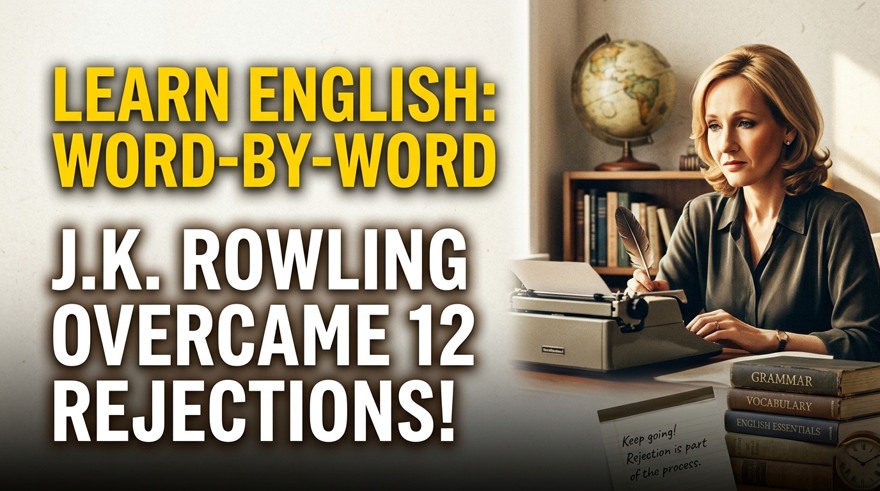
How J. K. Rowling overcame 12 rejections | Learn English Word-by-Word
Before she became a household name, J.K. Rowling was a struggling single mother with a manual typewriter and a dream. Many learners feel the same “rejection” when they struggle to understand a complex sentence or mispronounce a difficult term. However, the secret to mastering both a career and a language is the same: persistence.
In this guide, we will Learn English Word by Word by dissecting the journey of how Rowling navigated a sea of “No” to get to the “Yes” that changed literature forever. By analyzing her story, you won’t just learn about her resilience—ive will expand your vocabulary and grammar through the very narrative of her triumph over 12 skeptical publishers.
Takeaway for English Learners
What can J.K. Rowling teach us about English? 🎓
Her story is a masterclass in perseverance. Despite 12 rejections, she “stuck to her guns.” This idiom is perfect for language learners: it means staying firm in your purpose even when things get tough. Don’t fear the mistakes; they are just the chapters leading to your success. 🌟
#ESL #WordByWord #CareerGrowth #Storytelling #Mindset
The Story: How J.K. Rowling Overcame 12 Rejections
Before Harry Potter became a global phenomenon, Jo Rowling was a struggling single mother living on benefits. She sent her manuscript to twelve different publishers, and every single one of them rejected it. It wasn’t until a small publisher named Bloomsbury took a chance on her that the “Boy Who Lived” finally found a home.
Actionable Tip for Learners
“It is impossible to live without failing at something, unless you live so cautiously that you might as well not have lived at all—in which case, you fail by default.” — J.K. Rowling
If you are learning English and feel frustrated by mistakes, remember Rowling’s 12 rejections. Every “no” or every “mistake” is just a step toward your eventual “yes.” Keep practicing!
What is a goal you are currently working toward that requires a lot of persistence?
To understand the full scope of J.K. Rowling’s journey from a delayed train to a multi-billion dollar franchise, we can break her path to success into 12 pivotal points.
The 12-Point Journey of Resilience
- The Initial Spark (1990): While sitting on a delayed train from Manchester to London, the idea for a scrawny boy who didn’t know he was a wizard “fell into her head.” She didn’t have a pen, so she spent four hours simply dreaming up the details.
- Personal Tragedy: Shortly after she started writing, her mother passed away. This profound grief deeply influenced the story, giving Harry’s own loss a much more “real” and heavy emotional weight.
- The Struggle in Portugal: Rowling moved to Portugal to teach English, got married, and had a daughter. However, the marriage ended in divorce, and she found herself returning to the UK as a single mother with nothing but her suitcase and three chapters of Harry Potter.
- Rock Bottom: Living in Edinburgh, she was “as poor as it is possible to be in modern Britain without being homeless.” She was diagnosed with clinical depression—an experience that later inspired the Dementors.
- The “Cafe” Office: Because her flat was cold and cramped, she would walk her daughter until she fell asleep in the stroller, then head to cafes (like The Elephant House) to write the rest of the manuscript by hand.
- Finishing the Manuscript: After years of writing, she finished The Philosopher’s Stone. She couldn’t afford a photocopier, so she manually typed out the entire 80,000-word book multiple times on an old typewriter to send to agents.
- The Search for an Agent: She was rejected by several agents before Christopher Little decided to represent her. He saw potential, but even he warned her that children’s books didn’t make much money.
- The 12 Rejections: Over the next year, the manuscript was sent to twelve major publishing houses (including Penguin and HarperCollins). Every single one rejected it, often saying the story was “too long” or “too complex” for children.
- The 13th Publisher: Finally, Nigel Newton at Bloomsbury agreed to look at it. He didn’t read it himself; he gave the first chapter to his 8-year-old daughter, Alice.
- The “Alice” Factor: Alice ran to her father after reading the first chapter, demanding to see the rest. This child’s genuine excitement was the only reason Bloomsbury offered Rowling a small contract.
- The $2,500 Advance: Rowling was given a small advance of roughly £1,500 ($2,500). Her editor still advised her to “get a day job” because there was very little chance of making a living from writing children’s books.
- The Global Phenomenon: In 1997, the book was published with a print run of only 500 copies. Word of mouth spread like wildfire. Today, the series has sold over 500 million copies and is translated into over 80 languages.
Key Takeaway for English Learners
Rowling’s story is a masterclass in perseverance. In English, we say she “stuck to her guns” (remained firm in her purpose). Whether you are writing a book or learning a new language, the “rejections” or mistakes you face are just the chapters that come before the success.
Quick Quiz: Vocabulary Check
Based on the story above, match the word to its meaning:
- Advance — A) A person who represents an author to publishers.
- Agent — B) An initial payment made to an author before the book is published.
- Print Run — C) The total number of copies of a book printed at one time.
(Answers: 1-B, 2-A, 3-C)
Frequently Asked Questions
1. How many rejections did J.K. Rowling receive for Harry Potter?
J.K. Rowling received 12 rejections from different publishing houses before Bloomsbury, a small London publisher, finally accepted the manuscript for Harry Potter and the Philosopher’s Stone.
2. What does the idiom “stuck to her guns” mean?
In English, to “stick to your guns” means to remain firm in your purpose, beliefs, or decisions, even when you face criticism or pressure to change. It is a perfect way to describe J.K. Rowling’s refusal to give up on her story.
3. How can J.K. Rowling’s story help me learn English?
By studying her journey “word by word,” learners can master vocabulary related to perseverance, storytelling, and professional success. Her story provides a real-world context for complex grammar and motivational idioms.
4. What is the best way to learn English “word by word”?
The “word by word” method involves breaking down high-interest stories (like Rowling’s) into smaller pieces. Instead of memorizing long lists, you focus on how specific words and phrases are used to build a narrative.
5. Why is perseverance important in language learning?
Language learning is a long-term journey. Like a writer facing rejections, a student will face mistakes. Perseverance ensures that you view these mistakes as “chapters” of growth rather than reasons to quit.
Conclusion: Your Story is Just Beginning
J.K. Rowling’s journey teaches us that the distance between failure and a global phenomenon is often just one more attempt. Whether you are facing 12 rejections from publishers or 12 confusing English tenses, the strategy remains the same: break it down. As you Learn English Word by Word, remember that even the most complex novels are built one small unit at a time. Rowling didn’t give up after the first, fifth, or tenth rejection; she trusted her words. If you continue to practice and build your vocabulary with that same unwavering grit, your fluency is not just a possibility—it is an inevitability. Keep reading, keep writing, and keep believing in the power of your own story.
If you found this word-by-word breakdown helpful, you can watch the full visual lesson on our YouTube channel, @TinyPositive. We believe that tiny steps in your language journey lead to massive positive shifts in your life.





 Life Quotes3 years ago
365 Depression Quotes and Sayings About Depression (Extremely Amazing)
- Inspirational Quotes3 years ago
342 Motivational & Inspirational Quotes
- Inspirational Quotes3 years ago
580 Motivational & Inspirational Quotes Life To Succeed
- Motivational Quotes3 years ago
600 Inspirational & Motivational Quotes About Life to Succeed
- Good Morning Quotes3 years ago
100 Beautiful Good Morning Quotes with Images That Will Enrich Your Day
- Sad Love Quotes3 years ago
110 Sad Life Quotes – Sad Quotes & Sayings About Sadness
- Sad Messages3 years ago
Top 70 Broken Heart Quotes And Heartbroken Sayings
- Inspirational Quotes3 years ago
97 Inspirational Quotes That Will Change Your Life