English Graded Reader
Our Mind Is Our Cage | Graded Reader
Have you ever felt like you are stuck in a routine, unable to reach your biggest goals? Sometimes, the biggest walls keeping us captive aren’t made of stone—they are the invisible barriers we build inside our own heads.
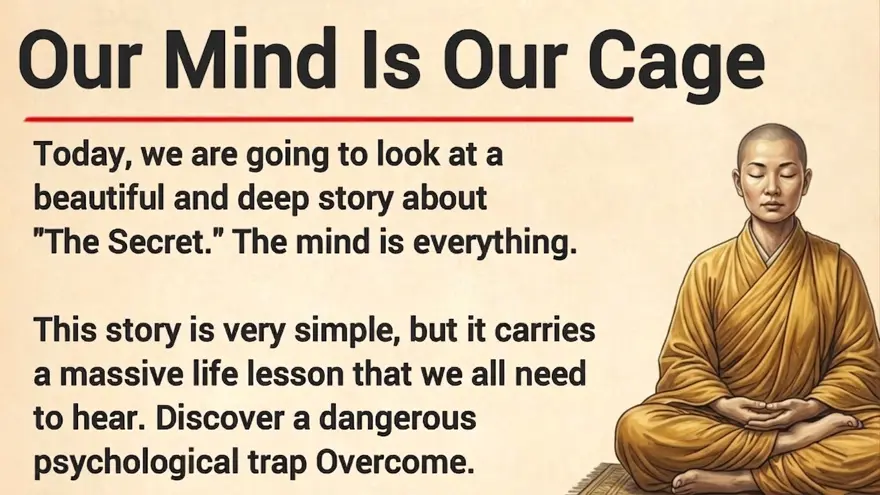
Welcome to today’s English Graded Reader lesson. In this post, we share an inspiring motivational story titled “Our Mind Is Our Cage.” We follow the journey of a traveler in the green hills of Thailand who discovers a profound life lesson from a group of massive elephants held captive by a simple, thin rope.
This story is written in simple, easy-to-understand English, making it the perfect tool for intermediate and beginner English learners to practice reading comprehension, expand vocabulary, and master natural sentence structures.
Grab a cup of tea, settle in, and let’s discover how to break free from the psychological traps holding us back!
🪶 The Invisible Rope: A Story of Hidden Strength
Chapter 1: The Heavy Chains of What We Know
There is a short phrase from ancient wisdom that holds a profound secret about human life: Gyanam Bandhanam. Translated from the old language, it means something that sounds very strange the first time you hear it: “Knowledge is bondage.”
At first, your mind wants to reject this idea. How can the things we know ever become a prison? We are taught from the time we are children that knowledge is power, that learning sets us free, and that education is the key to the world. But if you listen closely to the story that follows, you may begin to see a deeper truth. You may see that the heaviest, most painful chains a person carries throughout their life are rarely made of heavy iron bars or thick ropes. Instead, they are made of something we learned once, a long time ago, and never thought to question ever again. The only real limits we have in this life are the boundaries we choose to believe in. In a very real way, our own mind becomes our cage.
This is the story of a traveler who went on a long journey across the world. He traveled over oceans and across continents for a simple reason: he wanted to stand beside real, living elephants for the very first time in his life. He wanted to feel the greatness of nature. But in a quiet, peaceful camp tucked deep inside the green hills of Thailand, he found something much larger and more powerful than the animals he had paid to see.
In the quiet of those hills, he found a mirror that reflected his own life back at him. It showed him a truth about all of us: we do not see things as they really are in the world; we see them as we are. What this traveler saw in those gentle, gray giants would force him to stop and ask a question that most of us spend our entire lives running away from. There is a deep, unshakeable truth in the old saying that a person eventually becomes exactly what they believe themselves to be.
The traveler was about to learn just how real that saying is. He did not learn it from a wise book, and he did not learn it from a schoolteacher. He learned it from a thin piece of brown rope and a small wooden stick pushed into the dirt.
As you read through this story, listen to it not just as a tale about a far-off place, but as a question for your own soul. Ask yourself quietly: What is the invisible rope that has been holding me in one place, long after I grew strong enough to break it and walk free?
Chapter 2: The View Beyond the Screen
The traveler had come from a faraway land across the sea. For his entire life, he had only experienced the wonders of the world through glass. He had seen elephants on the television screen in his living room. He had watched them walk across dry plains in nature films, looked at frozen photographs of them in colorful magazines, and scrolled past short, quick videos of them on his mobile phone while sitting in traffic.
To him, these animals were not fully real. They were just flat pictures behind smooth glass. They were no more alive than a beautiful painting hanging on a dark wall.
So, when his van finally pulled up to the elephant camp in the misty, green hills of Thailand, he stepped out onto the dusty ground and immediately stopped in his tracks. He could hardly breathe. He could not believe what was standing right in front of his eyes.
Everywhere he looked, there were elephants. There were more of them than he could even count. They were absolutely massive, covered in thick gray skin, with wide ears that flapped slowly like sails in the wind. They had long, curling trunks that moved with incredible grace, and feet that were bigger than the heavy dinner plates in a restaurant.
As he watched, one of the giant animals walked over to a heavy log lying on the ground. It wrapped its trunk around the wood and lifted it into the air as easily as a grown man picks up a small twig. A little further away, another elephant pulled an entire leafy branch off a tall tree and raised it to its mouth for a snack.
No glowing screen had ever prepared him for this. No video had ever shown him how truly large, heavy, and powerful these animals were in real life. Standing near them, the traveler felt very small, like a tiny speck of dust next to a moving mountain.
Chapter 3: The Secret of the Tiny Stake
But then, as the traveler stood there watching the magnificent animals, his feelings of pure wonder slowly turned into deep confusion and surprise. He walked closer to the elephants and noticed how they were being kept in the camp.
Every single one of these giant animals was being held to the ground by nothing more than a thin piece of ordinary rope.
The rope was simply looped around one of the elephant’s thick back legs and tied tightly to a small wooden stake that had been pushed into the soft earth. The traveler looked closer, rubbing his eyes. The ropes were actually thinner than his own arm. The wooden stakes were so small and short that he was absolutely certain he could walk over, reach down, and pull one out of the ground using just two fingers.
Yet, as he stood there and watched, not a single one of the elephants tried to walk away. They did not pull against the string. They did not strain. They just stood there calmly, swaying their bodies slowly from side to side, treating the tiny wooden stakes beside them as if they were heavy iron chains bolted into solid rock.
The traveler could not understand it. It made no sense to his logical mind. Why would an animal that could push over a building stand still for a piece of string?
He walked through the camp until he found an old mahout—a traditional keeper who had spent his entire life living with, feeding, and caring for these beautiful animals. The traveler pointed toward the giants and asked the keeper plainly, “Sir, look at them. Any one of these elephants could break that tiny rope without even trying. They are strong enough to go anywhere they wish in these hills. Why do they just stand there? Why do they all stay tied to such a helpless little thing?”
Chapter 4: How a Mind is Trained
The old keeper looked at the traveler, and a gentle smile crossed his face. It was the kind of patient smile a person gives when they have been asked the exact same question hundreds of times before by travelers from all over the world. He looked out over the field at the great, quiet animals with kind and loving eyes.
“They stay,” the keeper said softly, “because of what they learned a long time ago, back when they were very young.”
The keeper gestured with his hands to show a small height. “You see, when each of these elephants was just a little baby—when it was small, weak, and no stronger than a human child—we used this exact same kind of thin rope, and we tied it to the exact same kind of wooden stake. Back then, when they were small calves, that rope really was strong enough to hold them.”
The old man turned back to the traveler. “The little elephant did not want to be tied up. It wanted to run free in the forest. So, it pulled and it pulled. It threw its whole body against the rope in the heat of the day, trying with all its might to break free. It tried again, and again, and again. It made its leg sore. But no matter how hard the baby elephant tried, the rope would not break, and the stake would not move.”
“Day after day, the young elephant fought against the rope,” the keeper continued. “And day after day, the rope won the battle. In time, after weeks of trying and failing, the little one just stopped fighting. It gave up. It did not stop because the rope had magically grown stronger. It stopped because something inside the elephant’s mind had changed forever. A single, heavy thought had taken root deep in its heart and stayed there. That thought was: This rope cannot be broken. It is impossible. There is no use in trying.“
The keeper paused, letting his words hang in the quiet air. “The years passed by. Each little calf grew up into the giant animal you see standing before you today. Its legs became as thick as the trunks of great trees. Its shoulders grew strong enough to smash through walls. The rope that had once held it when it was a baby is now nothing at all compared to its size—it is as weak as a single thread against a mountain. But because the elephant grew up believing it could never be free, it never pulled on the rope again. It does not even try.”
The keeper shook his head slowly. “They do not stay here because the rope has the strength to hold their weight,” he whispered. “They stay because they no longer believe they have the power to be free. The rope does not hold their leg anymore, my friend. It holds their mind.”
Chapter 5: The Prison of Memory
The traveler stood completely still for a very long time, unable to speak. He watched the great, beautiful animals as the orange sun began to sink down behind the dark green hills of Thailand.
One by one, the elephants shifted their massive weight from foot to foot. They breathed out slowly and deeply through their long trunks, sending a soft sigh through the camp, and settled down once more for the night right beside the small wooden stakes. They had made up their minds a long time ago that they could never leave this place. They had accepted their prison.
And as he stood there watching them in the twilight, the traveler stopped thinking about the elephants. He began to think about his own life. He looked down at his hands and realized something terrifying: he, too, carried heavy ropes that no one else could see.
He remembered times in his own past—years ago, when he was younger and less experienced—where he had tried something important to him and failed. He had tried to build something, or change his life, or reach a big dream, and it had not worked out. He had felt the pain of that failure, felt the rope hold him back, and slowly, without even noticing it, he had come to believe that he simply was not capable. He had told himself, I am not the kind of person who can do this.
He had stopped trying. He had never checked or tested that limit ever again, even as the years went by and he grew older. Like the giant elephants standing in the dirt, he was no longer the small, weak, helpless person who had failed all those years ago. He had gathered wisdom, he had gained experience, and he had grown stronger. Yet, he was still living his daily life as if that old defeat from his past were a permanent law of the universe.
Then, the full meaning of the ancient phrase rushed over him. It was not the rope that held the elephant captive. It was what the elephant knew to be true. It was its absolute certainty that the rope could not be broken. That single, old piece of knowledge had become the real chain around its leg. The very thing it had learned in its youth was the exact thing that now kept it trapped in the dark.
The traveler turned around to leave the camp as the stars began to appear in the night sky. He carried away one quiet, burning thought: The limits we choose to believe in will hold us more tightly than any iron chain ever forged by man.
Before we ever look at a dream or a goal and decide that it is completely impossible, we must have the courage to test it one more time. We must find out whether the rope is actually holding us today, or if we are just being held by the ghost of an old memory. For the strength to break completely free may already be living inside us, simply waiting for us to find the bravery to pull.
Chapter 6: The Quiet Human Tragedy
The elephant in this story was never truly trapped by a physical object. It was trapped by a single, solid belief that was formed when it was small and weak: I cannot break free. The rope had stopped being strong enough years ago, but because the animal stopped fighting, it stayed a prisoner.
This is the quiet, hidden tragedy of so many human lives. Most of us are not held back in life by things that are actually impossible for us to achieve. We are held back because we have looked at our past failures and decided that success is impossible for us.
The great teacher Buddha said it very simply: “We are what we think. All that we are arises with our thoughts. With our thoughts, we make the world.” And he said it again: “The mind is everything. What you think, you become.”
The elephant became exactly what it believed itself to be: small, helpless, and unable to move. And we do the exact same thing to ourselves every single day.
When we look in the mirror or lie awake at night and tell ourselves that we are not smart enough, or not strong enough, or not good enough to change our lives, we are not describing the real world. We are not stating facts. What we are actually doing is building the walls of our own cage, brick by brick. As the insightful writer Richard Bach once wrote: “Argue for your limitations, and sure enough, they’re yours.” If you fight to prove that you cannot do something, you will always be right.
What once held you back in your life may have absolutely no power over you today. The elephant was actually right to give up when it was a little baby calf. At that specific time in its life, the rope genuinely was stronger than its muscles. The failure wasn’t in the fact that it stopped pulling back then; that was just common sense. The real tragedy was that it never checked the rope again once it had grown up into a giant.
We do this to ourselves constantly. We carry forward old conclusions, old rejections, and old hurts from a weaker, younger, less experienced version of ourselves, and we treat them as if they are permanent, unchangeable truths. We walk around today obeying the rules made by a frightened child from our past, never noticing how much we have changed, how much we have learned, and how much stronger we have become through the storms of life. A single defeat is just an event that happened on a Tuesday years ago. But if we are not careful, that repeated failure quietly turns into our identity. It becomes who we think we are.
Chapter 7: The Freedom of the First Pull
We start saying things like: This just can’t be done. I’m just not the kind of person who succeeds at this. Once that thought slips into your heart and settles down, you stop trying. And that lack of trying is the exact thing that actually keeps you stuck in place.
The physical rope only holds the leg for a short season of life. But the memory of the rope can hold a soul for an entire lifetime.
True freedom almost always begins with a single, honest, heavy pull. The giant elephant could be walking free through the beautiful green hills of Thailand the very second it chooses to lean its great weight into that old string. The lesson of this story isn’t a loud, empty promise that “you can do absolutely anything in the world.” The lesson is much gentler, much deeper, and much truer than that:
Do not let an old verdict from your past decide your present life without re-examining it today.
The strength you completely lacked back then might already be resting in your hands right now. The only way to find out the truth is to walk over and put your weight against the very thing you have always assumed you could not move.
Think about your own journey for a moment. Think about it honestly as you read these words. What did you try to do once, a long time ago, that did not work out?
- Maybe you failed an important exam at school.
- Maybe you faced a painful rejection from someone you cared about.
- Maybe you lost a business or a job that mattered deeply to you.
- Maybe someone you looked up to told you to your face that you would never amount to anything good.
And maybe, just like that little baby elephant, you pulled against that heavy rope a few times, felt the sharp pain of it holding you back, and quietly decided to stop trying.
But here is the great truth that you may have forgotten in the rush of life: You are no longer the small, weak version of yourself that first failed. You have grown through the years. You have learned hard lessons. You have survived difficult days. The rope that held you fast back then may be nothing more than a thin, rotten thread in your hands today.
Our limits, just like our deepest fears, are very often just illusions that we keep alive simply because we refuse to step up and test them. This is the ultimate meaning of Gyanam Bandhanam. What we think we “know” about ourselves—our absolute certainty about what we cannot do—is the very prison we never think to question.
But the philosopher Ralph Waldo Emerson reminds us of a beautiful truth. He said that what lies behind us in our past, and what lies before us in our future, are tiny, insignificant matters compared to what lies living right inside us.
The power to break free from your invisible chains is already inside you. It has been there the entire time, waiting for you to notice it.
Chapter 8: A Promise to Yourself
So, here is what you can do, starting this very day. Do not try to change your whole life at once. Just pick one rope.
Think of just one thing in your life that you decided a long time ago you simply could not do, and go test it again. Just once.
Go apply for that job or that position you assumed you would never get. Speak the honest words to someone that you have been too afraid to say out loud for years. Begin taking the first small steps toward the work or the dream that you convinced yourself you were not capable of handling. You may be absolutely beautiful surprised to find that the heavy stake lifts right out of the ground with the gentlest pull of your hand. Because, as the wise leaders of the world have always told us, it always seems completely impossible until it is finally done.
Whatever invisible rope you have been tied to for all these years, look at it, walk forward, and pull against it one more time with everything you have. Never give up on yourself. Do not allow your life to be bounded by the rules of yesterday’s limitations. The strength to walk away into freedom is already there, waiting for you to try.
Now, I want you to take a deep breath and think about this deeply. What is the one invisible rope that has kept you tied to a small wooden stake for far too long? What is the one limit from your past that you are finally ready to test with an honest pull today?
Let that choice become a quiet, unbreakable promise that you make to your own heart today.
We share these stories of forgotten wisdom for a simple reason: most of us are already wise enough to know these truths deep down in our souls. We don’t need to be taught anything new. We have simply forgotten who we are somewhere along the way, buried beneath the heavy noise, the constant stress, and the endless rush of a busy life. Through these words, we want to bring back a little bit of hope, a warm smile, and a quiet moment of happiness and peace to your day.
If this story spoke to something quiet inside your heart, share these words with someone else who needs to hear them—someone who is still standing completely still in their life beside a tiny stake that they outgrew a long, long time ago. Keep walking this journey of awakening wisdom. Be patient with yourself, stay deeply grateful for how far you have already come, and always remember: the rope that once held you down has no real power over you today.
The strength to break free has been resting within you all along. You only have to try.
Conclusion
Engaging & Interactive Conclusion (approx. 150 words)
The tragedy of the elephant in our story isn’t that it failed when it was a small baby. The true tragedy is that it never checked the strength of the rope again once it grew powerful.
How many of us are living our lives based on old rejections, childhood fears, or past failures? Remember, you are no longer the weak or inexperienced person who failed years ago. You have grown, you have learned, and you have survived. The mental chains holding you back today are nothing more than an illusion. It is time to lean into that rope and take an honest pull toward your dreams.
💬 Let’s Practice Your English!
We love hearing from our global community of English learners. Answer these questions in the comments section below to practice your English writing skills:
- What is one “invisible rope” or old limitation you are ready to break free from today?
- What was your favorite new vocabulary word from this story?
Don’t forget to bookmark this blog and subscribe to our newsletter for more weekly stories to upgrade your mindset and your English fluency!

 Life Quotes3 years ago
365 Depression Quotes and Sayings About Depression (Extremely Amazing)
- Inspirational Quotes3 years ago
342 Motivational & Inspirational Quotes
- Inspirational Quotes3 years ago
580 Motivational & Inspirational Quotes Life To Succeed
- Motivational Quotes3 years ago
600 Inspirational & Motivational Quotes About Life to Succeed
- Good Morning Quotes3 years ago
100 Beautiful Good Morning Quotes with Images That Will Enrich Your Day
- Sad Love Quotes3 years ago
110 Sad Life Quotes – Sad Quotes & Sayings About Sadness
- Sad Messages3 years ago
Top 70 Broken Heart Quotes And Heartbroken Sayings
- Inspirational Quotes3 years ago
97 Inspirational Quotes That Will Change Your Life