English Graded Reader
Value of Time | The Secret of the Golden Bowl | Graded Reader
Have you ever felt like life is slipping through your fingers, but you can’t quite catch it? Most of us are pursued by a quiet thief—procrastination—that steals our most valuable asset: our time. We comfort ourselves with the word “tomorrow,” never realizing that each one is paid for with a piece of today that will never return.
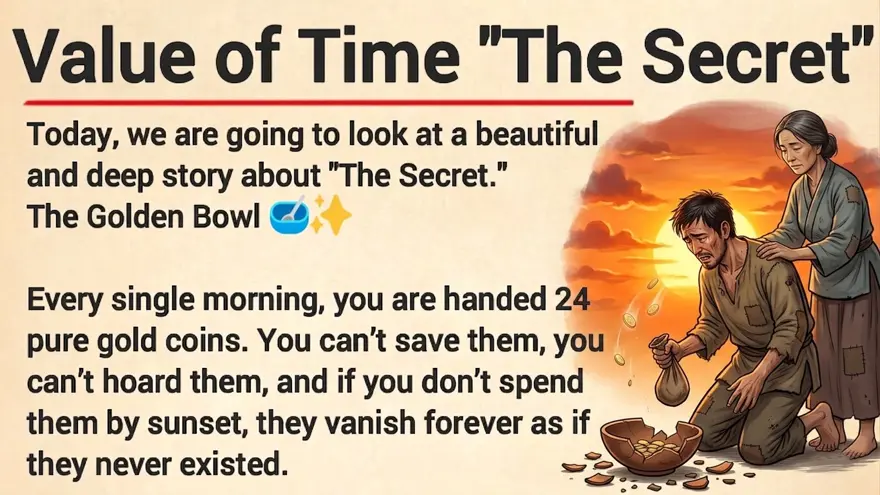
Today, we look at a beautiful and deep story about “The Secret” of the Golden Bowl. Imagine waking up every single morning to find 24 pure gold coins in your hands. You cannot save them, you cannot hoard them, and if you don’t spend them by sunset, they vanish forever as if they never existed. This is the reality of the 24 hours we are given each day.
This post features a masterfully expanded storytelling version of this ancient parable, written in simple, immersive English—perfect for readers and language learners alike. Sit quietly, and as you read, ask yourself: “Am I holding a bowl of gold and watching the sun go down without using it?”
Chapter 1: The Invisible Thief
There is a quiet thief who walks through every home, enters every life, and steals into every dream. Most of us never notice him until our hands are completely empty. He does not steal your money, your possessions, or your gold. He steals something far more precious. He steals your time.
We comfort ourselves with a gentle, dangerous little word: “tomorrow.” We say it softly, never realizing that every tomorrow we whisper is paid for with a piece of today—a piece that will never return.
Remember this truth: Time and tide wait for no man.
This story comes from old village wisdom. It is a parable of a poor man, a divine bowl, and a lesson written in gold and dust. It is the story of a man who was given everything he ever prayed for, yet remained poor until his very last breath.
Why? Because the greatest gift of heaven means nothing in the hands of someone who worships the word “later.”
So, sit quietly for the next few minutes. As you read, gently ask yourself: “Am I, too, holding a bowl of gold in my hands, watching the sun go down without using it?” Pay close attention to the end of this story, because the lesson it carries may be the very message your soul has been waiting to hear.
Chapter 2: The Curse of Tomorrow
In a small village nestled between green paddy fields and a slow-flowing river, there lived a poor man with his devoted wife and their four small children. Their life was hard. Their small hut leaned heavily to one side, the straw roof was thin, and the cooking pot was empty far more often than it was full.
The man was not a cruel person. His heart was soft, his speech was gentle, and he had never struck his wife or scolded his children. But he carried a curse heavier than any whip. He was incredibly lazy, and he was a total slave to the word tomorrow.
When the rooster crowed loudly at dawn, he would simply pull his thin blanket over his head and mutter, “Just a little more sleep. The work can wait.”
When his neighbors went out to work in the fields, he would look outside and say, “The sun is too hot today. I shall go tomorrow.”
When his wife begged him to fix the leaking roof before the heavy rains arrived, he would smile calmly and answer, “There is still time, my dear. Plenty of time.”
And so, while his neighbors worked hard and grew rich, this man’s family sank deeper and deeper into hunger. His wife ground the very last handful of grain with trembling fingers, wondering with a heavy heart what she would feed her children when the morning came.
Chapter 3: The Gift from the Forest
One evening, unable to bear the cries of her hungry children any longer, the wife wrapped her torn shawl tightly around her shoulders and walked down the dusty road toward the deep forest.
The villagers often said that a great wise man, a holy Sadhu, had taken his seat beneath an ancient banyan tree at the edge of the woods. They said that those who truly sought his blessing never returned empty-handed.
She found him there in the fading evening light. His long white beard touched his chest, his eyes were closed in deep meditation, and sacred ash was smeared across his forehead. She fell to her knees at his feet and began to weep.
“Guruji,” she whispered through her tears, “my husband is good at heart, but he wastes every single day in sleep and excuses. We are drowning in poverty, and my children’s bones are showing through their skin. Bless us, holy one. Show us a way out of this misery before we die.”
The Sadhu slowly opened his eyes—eyes as deep as still forest pools—and gazed upon her kindly for a long moment. Then, he reached behind him and brought forth a simple clay bowl. It was plain, unpainted, and looked completely ordinary.
“Daughter,” the Sadhu said softly, “this is no ordinary vessel. It is an Akshaya Patra—an inexhaustible, magical bowl. Listen very carefully to its sacred law.”
The wife folded her hands respectfully and listened with all her heart.
“At every sunrise,” the wise man explained, “this bowl will automatically fill itself with 24 gold coins of the purest metal. But hear this well, daughter: at every single sunset, whatever coins remain unspent inside the bowl will vanish instantly, as though they had never existed. Nothing can be saved. Nothing can be carried over into tomorrow’s dawn. You cannot keep the coins as they are. You must spend them on food, on clothes, on land, or on whatever brings real life and strength to your home. If you do not spend them, they will be lost forever.”
Her eyes filled with tears of pure joy. She pressed the clay bowl to her forehead in deep gratitude, touched the Sadhu’s feet, and ran all the way home through the dark. She clutched the bowl tightly against her chest like a sleeping child.
Chapter 4: The Golden Morning
When she reached the hut, breathless and glowing with excitement, she placed the bowl right before her husband and told him every single word the Sadhu had spoken.
The man’s mouth fell open in shock. He turned the simple clay bowl over and over in his hands, scarcely believing his own ears.
“Twenty-four gold coins?” he whispered. “Every single morning?”
“Every single morning, my husband,” she replied urgently. “But we must spend them completely before the sun goes down, or they will vanish into thin air.”
That night, neither of them could sleep. They lay awake in the dark hut, dreaming together of all the wonderful things they would do. They imagined a great, beautiful house with a sturdy tiled roof. They dreamed of owning a healthy herd of cows, fertile farming land along the river, beautiful silken clothes for the wife, gold ornaments for the children, and a grand wedding for their eldest daughter. They dreamed and dreamed until the rooster crowed.
And then, the very first ray of sunlight slipped through the cracks in the wooden wall.
Both of them rushed to the corner to look into the bowl. There they were: 24 golden coins gleaming brightly like little suns! Each one was heavy, warm, and stamped with the seal of an ancient kingdom.
The man lifted the gold in his palms and laughed out loud like a happy child. His wife touched the coins to her forehead in deep thankfulness.
For the first time in many years, the family ate a wonderful, proper meal. The wife took just a single gold coin, hurried to the village market, and returned with fresh rice, lentils, vegetables, rich butter, and long pieces of clean cotton cloth for the children. The little ones laughed and clapped their hands in delight. The broken hut, for one brief morning, felt exactly like a grand palace.
Chapter 5: The Lazy Walk to Town
After the morning meal, the wife turned to her husband with bright, shining eyes.
“My dear, we must hurry now!” she urged. “Take the remaining coins to the great market in the next town. Buy us a better house. Buy a piece of land along the river. Buy jewelry that we can keep forever. Buy strong animals and a plow for farming. Quickly, my husband, go before the sun sets, before the coins vanish!”
The man patted his full stomach contentedly, stretched his arms wide, and yawned.
“Oh, my dear wife, why do you worry so much?” he said lazily. “The whole day stretches before us. Let me first finish my breakfast in peace. A man cannot work well on an empty stomach, can he?”
He ate incredibly slowly, savoring every single grain of rice and every drop of soup, acting as though he had all the time in the world. His wife watched the sun climbing higher and higher into the sky, and her heart began to flutter with deep worry.
When the meal was finally finished, the man rubbed his belly and yawned again.
“Such a heavy meal,” he muttered. “The sun is still high in the sky. There is plenty of time before evening. Let me rest just a little bit. A short nap will give me the strength I need for the long walk to the market town.”
He lay down upon his old mat. He told himself he would sleep for only a few minutes.
But when he finally opened his eyes, the sun was directly overhead. It was already noon.
“Oh!” he cried out, sitting up quickly. “I have slept too long. I must hurry!”
He took a small cloth sack, poured the 23 remaining gold coins into it, tied it tightly around his waist, and set off down the dusty road toward the market town.
Chapter 6: The Shade of the Tree
The afternoon sun was completely merciless. It beat down heavily upon his head and shoulders. His feet grew sore from the hot ground, and his mouth became completely dry. The long road shimmered with heat, and the market town still seemed very far away.
The man had walked only a short distance when he came upon a great, beautiful tree spreading its cool, dark shade across the road. Beneath the branches, the earth was dark, cool, and mossy, and a soft breeze whispered gently through the leaves.
The man stopped in his tracks. He wiped the heavy sweat from his forehead.
“Why am I rushing so much?” he asked himself. “The magical bowl is perfectly safe at home. Tomorrow morning, the sun will rise again, and 24 brand-new gold coins will appear inside it. Even if I spend absolutely nothing today, what does it really matter? There will always be more gold tomorrow. Let me rest just a few minutes beneath this lovely, cool tree, and then I shall continue my walk.”
He sat down on the soft earth. He leaned his tired back against the cool trunk of the tree and placed the sack of gold right beside him. The leaves rustled softly above his head, a bird sang a sweet song from a distant branch, and his eyelids immediately grew as heavy as stones.
He told himself he would rest for only a single moment.
When the man opened his eyes again, something was terribly wrong with the light. The shadows on the ground had grown incredibly long. The leaves above him were glowing orange and red. The sky was streaked with deep crimson and purple, and the great circle of the sun hung dangerously low on the western horizon. It was sinking fast.
The man leapt to his feet with a terrified cry.
“The market! The coins! Oh, what a fool I am! What a fool!”
He snatched up the cloth sack and began to run. He ran faster than he had ever run in his entire life. His chest burned with every breath, his legs ached with pain, and the dusty road flew beneath his feet.
The market town finally came into view—he could see the rooftops, the tall temple spire, and the smoke rising from evening cooking fires. But just as he reached the very first lane of the marketplace, the last sliver of the sun slipped completely behind the distant hills.
The sky turned dark. Night had arrived.
The man stopped running, gasping for air in the middle of the empty, quiet street. With trembling hands, he untied the cloth sack and looked inside.
It was completely empty. Not a single gold coin remained. The gold had vanished into thin air, as though it had never been there at all. He sank to his knees in the dust, covered his face, and wept bitterly.
Chapter 7: The Shattered Vessel
He returned home in the pitch dark, his head bowed low, his empty sack hanging limp in his hand. His wife saw his sad face and understood everything without a single word being spoken.
She did not scold him. She did not yell. She only sighed heavily and stirred the thin, watery soup over the small fire.
“Tomorrow, my husband,” she said softly. “Tomorrow, you will do better.”
And when the next sunrise came, the magical bowl indeed filled itself again with 24 gleaming gold coins. She placed them into his hands with tears of hope in her eyes, begging him to hurry straight to the market.
But the exact same thing happened. The man ate too slowly. He rested briefly after his meal. He started his journey far too late. He grew tired upon the dusty road. He sat down beneath the cool shade of the tree and told himself: “The bowl is not going anywhere. Tomorrow there will be more coins. Why should I rush today?”
He closed his eyes for just a moment, only to wake up and find the sun setting, the gold vanishing, and the day lost forever.
Day after day, this is exactly how it went. Day after day, his wife placed the coins in his hands with hope. Day after day, the man returned at nightfall with an empty sack and a heavy heart.
The family remained just as poor as they had been before. The roof still leaked water when it rained, the children still went to bed with empty stomachs, and the divine bowl—which could have made them richer than kings—sat quietly in the corner of the hut, a silent witness to a man’s completely wasted days.
One terrible morning, the man woke up even later than usual. He walked sleepily and carelessly toward the corner to collect his daily coins.
As he walked, his foot caught upon the ragged edge of the cooking mat. He stumbled forward. The magical bowl slipped right out of his lazy fingers.
It fell hard upon the earthen floor.
Smash!
The divine clay vessel shattered into a hundred tiny pieces.
For one frozen moment, the man could only stare in horror. Then, he fell to his knees among the broken shards. He gathered the broken pieces in his trembling hands, trying desperately to fit them back together. He pressed the broken clay to his chest and cried out in agony. He wept the way a man weeps when he realizes he has lost something precious that he can never, ever recover.
His wife came running into the room. When she saw the broken pieces on the floor, she said absolutely nothing. She only sat down quietly beside her husband and laid a gentle, comforting hand upon his shaking shoulder.
The sun rose the next morning, and the sun set that evening. But no gold coins ever came again.
Chapter 8: The 24 Golden Coins of Life
My dear friend, pause for a moment right now and let this story sink deep into your heart. Because this story is not truly about a poor man in some forgotten village of the past.
This story is about you. This story is about me.
This story is about every single human soul who has ever whispered that lazy word: “tomorrow.”
That magical clay bowl is not a fairy tale. It is completely real, and you are holding it in your hands at this very moment. Every single morning when you open your eyes and the first light of dawn touches your face, the divine bowl of your life automatically fills itself with 24 golden coins.
They are not coins made of metal, but coins of time.
Twenty-four gleaming hours! Each one is heavy with incredible possibility, and each one is given to you as a gift from heaven itself. And just like the magical bowl in our story, when the sun goes down, whatever hours you have not spent wisely will vanish forever.
You cannot save an hour. You cannot lock a single minute away in a box to use later. You cannot carry today’s time into tomorrow. As the wise have said: Time is what we want most, but what we use worst.
The lazy man in our story did not lose his wealth because the universe was cruel to him. He lost it because he believed a terrible lie—the lie that fools every single generation. It is the lie that there will always be more tomorrows.
He thought, “The bowl is safe. Why should I hurry today?” And so he ate slowly, he rested too much, he started too late, and the sun set on his dreams day after day.
How many of us live our lives in exactly the same way?
- We say we will start that new business tomorrow.
- We say we will call our lonely parents tomorrow.
- We say we will read that book, begin that prayer, fix that broken relationship, or take the very first step toward our dreams tomorrow.
But remember this ancient wisdom: Procrastination is the thief of time. And remember this even more deeply: You may delay, but time will not.
Chapter 9: Before the Bowl Breaks
Look at how the story ends. The bowl eventually breaks.
One day, for every single one of us, our bowl will break, too. The day will surely come when no more sunrises will fill our hands with golden hours. And on that final day, what will matter is not how many coins we were given throughout our lives, but how many we actually spent on love, on hard work, on kindness, and on becoming the person we were truly meant to be.
The sun does not stop moving because you are tired. The hours do not slow down because you are not ready. Whether you choose to sit lazily beneath the shade of a tree or walk bravely toward your goals, the day moves forward at the exact same speed. And at sunset, it is gone forever.
Procrastination does not break down your front door. It does not shout or announce itself. It simply sits down quietly beside you, whispers gently in your ear, “Do it later,” and walks away with priceless hours of your life that you can never get back.
So, please, hear these words clearly: Stop waiting. Stop dreaming without doing.
The two greatest gifts you have been given in this life are patience and time. The famous saying tells us that the two most powerful warriors are patience and time. But having patience without taking action is just laziness dressed up in good clothing.
The dreams inside your heart—the book you want to write, the skill you want to learn, the forgiveness you need to offer, the journey you want to begin—that is your market town in the distance. The tree of comfort and laziness will always whisper to you sweetly, telling you to rest. But remember: the sun is setting. The sun is always setting.
Yesterday is completely gone. Tomorrow has not yet arrived. We only have today. Let us begin.
Look closely at the people whose lives you truly admire. They were not given extra hours in their day. They receive the exact same 24 golden coins that you do. The only difference is simple: they spend them.
They wake up and they begin. They do not wait until they are perfectly in the mood, they do not wait for the weather to be perfect, and they do not wait for a flawless plan to appear.
Start before you feel completely ready. Walk before the road looks perfectly easy. Use today’s coins today, because no power on earth can return a single hour that has already slipped past the horizon.
The Six Truths to Keep in Your Heart
Let these six powerful lessons stay with you forever:
| No. | The Golden Rules of Time |
| 1 | Time and tide wait for no man. |
| 2 | The two most powerful warriors are patience and time. |
| 3 | Time is what we want most, but what we use worst. |
| 4 | Yesterday is gone. Tomorrow has not yet come. We have only today. |
| 5 | Procrastination is the thief of time. |
| 6 | You may delay, but time will not. |
What is the one thing you have been putting off for far too long? What is that one dream sitting in the corner of your heart, waiting for a “tomorrow” that never comes? Let this very moment be the time you finally stand up and begin.
Be grateful for the day, and remember: every single sunrise places 24 golden coins into your hands. Spend them beautifully, because the sun is already moving. Your life is waiting. Begin today.
🙋♂️ Frequently Asked Questions (FAQ)
Q: Who is this story intended for? A: This story is designed for English learners looking to improve their reading comprehension and vocabulary through an immersive “Graded Reader” style. It is also intended for anyone seeking motivation to overcome procrastination and improve their time management.
Q: What is the “Akshaya Patra” mentioned in the story? A: In the story, the Akshaya Patra is a divine, inexhaustible clay bowl given to the poor man by a wise sadhu. It serves as a metaphor for the 24 hours we are given each day, which must be “spent” on meaningful actions before the day ends.
Q: Why do the gold coins vanish at sunset? A: The coins vanish to teach the lesson that time cannot be saved, hoarded, or carried over into tomorrow. Once the sun sets, that specific day is gone forever, regardless of whether you used your time wisely or wasted it.
Q: What does the “shattered bowl” symbolize? A: The breaking of the bowl symbolizes the end of a person’s life or opportunities. It serves as a reminder that our time is limited, and we will not always have the “next sunrise” to pursue our dreams.
Q: What are the “6 Golden Truths” of time mentioned in the story?
A: The six lessons are:
- You may delay, but time will not.
- Time and tide wait for no man.
- The two most powerful warriors are patience and time.
- Time is what we want most, but what we use worst.
- Yesterday is gone; tomorrow has not yet come; we have only today.
- Procrastination is the thief of time.
Conclusion
The story of the shattered bowl serves as a powerful mirror for our own lives. One day, for every one of us, the bowl will break, and no more sunrises will fill our hands with golden hours. When that day comes, what will matter is not how many coins we were given, but how we spent them on love, kindness, and becoming the person we were meant to be.
Remember these 6 Golden Truths:
- Time and tide wait for no man.
- Patience and time are the two most powerful warriors.
- Time is what we want most, but use worst.
- Yesterday is gone; tomorrow is not yet here. We have only today.
- Procrastination is the thief of time.
- You may delay, but time will not.
Don’t wait for the mood to be perfect or the plan to be flawless. Stop dreaming without doing and start using today’s coins today.
What is the one dream you have been postponing for too long? Let this be the moment you finally begin. Share your thoughts in the comments below and pass this story on to someone who needs to hear it today.


 Life Quotes3 years ago
365 Depression Quotes and Sayings About Depression (Extremely Amazing)
- Inspirational Quotes3 years ago
342 Motivational & Inspirational Quotes
- Inspirational Quotes3 years ago
580 Motivational & Inspirational Quotes Life To Succeed
- Motivational Quotes3 years ago
600 Inspirational & Motivational Quotes About Life to Succeed
- Good Morning Quotes3 years ago
100 Beautiful Good Morning Quotes with Images That Will Enrich Your Day
- Sad Love Quotes3 years ago
110 Sad Life Quotes – Sad Quotes & Sayings About Sadness
- Sad Messages3 years ago
Top 70 Broken Heart Quotes And Heartbroken Sayings
- Inspirational Quotes3 years ago
97 Inspirational Quotes That Will Change Your Life