Zen Buddhism
Don’t Overthink It: The Powerful Zen Buddha Story on Perseverance
Have you ever looked at a massive goal and felt instantly paralyzed by how far you still have to go? In our fast-paced world, it is incredibly easy to overthink the journey, become overwhelmed by the sheer distance, and want to drop your bag and give up entirely.
When your mind starts telling you, “Maybe I cannot do this,” what you actually need isn’t a map of the whole mountain—you just need the courage to take the very next step.
In this chapter-wise Zen motivational story, we follow Buddha and his close disciple, Ananda, as they journey down a long, exhausting forest path toward a distant town. Tired, frustrated, and losing light, they encounter three different villagers who all offer the exact same piece of advice: “The town is just two miles away.” Why does Buddha laugh every time he hears this apparent lie? The deeper psychological lesson behind his laughter holds a profound secret about human nature, consistency, and how to overcome the heavy trap of overthinking.
Whether you are trying to learn a new skill, build a dream, or simply push through a difficult season in your life, this timeless story will shift how you look at your daily struggles.
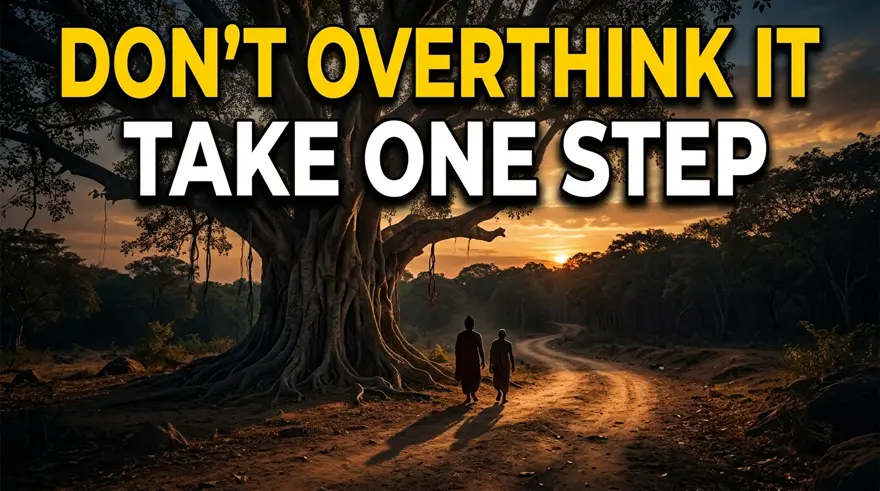
Chapter 1: The Long Shadow of the Sun
The day was bleeding into dusk. The sun, once a fierce eye in the sky, was now dipping low, casting long, tired shadows across the dusty path. Buddha and his disciple, Ananda, were walking. They were moving quickly, their sandals kicking up small clouds of dry earth, driven by a singular, urgent goal: to reach the village before the light vanished completely.
Both men were weary. The weight of their years showed in the way they moved—shoulders slumped, steps dragging. Ananda, though devoted, was feeling the heavy toll of the trek. They had been walking for hours, and the horizon seemed to stretch out like an endless, taunting line.
They approached an old farmer, his body bent like a bow from a lifetime of tilling the soil. Ananda stopped, wiping sweat from his brow. “Good man,” he called out, his voice raspy, “how far is the town from here?”
The farmer looked up, his eyes crinkling at the corners. He offered a warm, gentle smile. “Oh, do not fret, traveler. It is not far at all. Just two miles. You will reach it soon. Just keep walking.”
Buddha smiled softly at the farmer, and the farmer smiled back. Ananda, however, felt a flicker of confusion. Two miles? he thought. Surely we have walked more than that already. Yet, the kindness in the man’s eyes held him back from questioning further. They pressed on.
Chapter 2: The Recurring Promise
They walked for another two miles. The town did not appear. The woods grew denser, and the silence of the forest deepened. Their fatigue had settled deep into their bones, a heavy, aching presence.
Just as their spirits began to flag, they encountered an old woman gathering wood near the trail. Her face was etched with the lines of many winters, yet her expression was serene. Ananda, desperate for relief, asked, “Mother, how much further is the town?”
She looked at them, her eyes full of empathy. “Not more than two miles, dear ones,” she replied soothingly. “You have almost arrived. Do not worry. Just continue your journey.”
Buddha laughed—a light, musical sound that seemed to dance through the trees. The old woman laughed with him. Ananda stood frozen, bewildered. What is this? he wondered. Why are they laughing? Still, they continued to walk.
Two miles passed again. The town was nowhere to be seen. Their legs felt like lead. They met a third traveler on the path, and once again, the question was asked. Once again, the answer was the same: Two miles.
Chapter 3: The Breaking Point
Ananda could take no more. He let his heavy bag drop to the dirt with a final, defeated thud. He sat down right there on the roots of a massive tree, his face etched with frustration.
“I am finished,” he said, his voice trembling. “I will not move another step. We are never going to cross these two miles. Three times we have been told the same thing, and three times it has been wrong. It is a lie, Buddha. It is all a lie.”
Ananda had lived with Buddha for forty years. He knew the master’s nature—he knew better than to demand answers to trivial things. But this was different. The exhaustion had stripped away his composure.
“I don’t care if it is necessary or not,” Ananda confessed, looking up at his teacher. “You have to tell me: Why were you laughing? With the farmer, with the woman, and with the third man—what was that exchange? What was passing between you?”
Chapter 4: The Compassion of the Lie
Buddha sat down on the grass, his expression calm and serene. He looked at his exhausted disciple and spoke gently.
“Ananda, our profession is the same,” Buddha began. “When I laughed, they laughed because they understood. They are in the same business that I am in: the business of encouraging people.”
Buddha gestured toward the path. “If I had told you at the start that the town was twenty miles away, your heart would have dropped. You would have collapsed right there at the beginning. But by offering you ‘two miles,’ and then ‘two more,’ I allowed you to cover those twenty miles without the crushing weight of the distance breaking your spirit.”
“I knew the town was not two miles away,” Buddha continued. “I have walked this road before. I knew we would not reach it tonight. But what was the harm in their encouragement? Those villagers were compassionate. They were not lying to deceive you; they were lifting your spirit so you could continue. You only needed a few more people like them, and you would have arrived.”
Buddha smiled, patting the ground beside him. “It is okay, Ananda. We will sleep under this tree tonight. But remember: the town is still not just two miles away.”
Chapter 5: The Wisdom of the Single Step
In life, we all face journeys that feel impossible. We look at the mountain in front of us and are paralyzed by the sheer height of the peak. We become tired, not because the goal is out of reach, but because we are carrying the weight of the entire journey in our minds at once.
Fear grows when we look at the distance yet to be traveled. But hope grows when we look at the next step.
- A student does not master a subject in a single hour.
- A masterpiece is not painted in a single stroke.
- Rome was not built in a day.
Do not try to carry the whole road in your mind. If your dream feels too far, do not stop. Simply tell yourself, “Just a little more. Just one more step.”
Big goals are not difficult because they are impossible; they are difficult because we try to swallow them whole. Break your life down into small, manageable pieces. Complete one task. Take one step. Then another. Slowly, those small movements will turn into momentum, and your fear will be replaced by the quiet strength of progress.
When the road looks long and the end is nowhere in sight, do not despair. Just focus on the next step. Every great destination is reached exactly the same way: one small step at a time.
❓ Frequently Asked Questions
Q1: What is the main moral of the Zen Buddha story about the two miles?
A: The core message is that overwhelming goals become manageable when we stop overthinking the entire distance and focus solely on the next small step. The villagers’ encouragement represents the psychological tool of breaking down an immense journey into smaller, digestible pieces to prevent exhaustion and despair.
Q2: Why did Buddha laugh when the villagers said the town was only two miles away?
A: Buddha laughed because he recognized that the villagers were using the same “profession” or technique he used throughout his life—using compassionate encouragement to keep people moving forward. He knew the town was much farther away, but he appreciated their psychological wisdom in protecting Ananda’s flagging spirits from collapsing under the true distance.
Q3: How does overthinking affect our ability to achieve big goals?
A: Overthinking causes us to carry the weight of the entire road in our minds all at once. When we obsess over how much progress is left to make, fear and mental fatigue become stronger than hope, leading to analysis paralysis or quitting prematurely.
Q4: What is the best way to apply this Zen story to modern daily life?
A: Whenever a project, habit, or life change feels too difficult, pause and narrow your focus. Instead of worrying about the ultimate destination, ask yourself, “What is one small task I can masterfully complete in the next hour?” Consistently taking these micro-steps naturally builds momentum and quietly brings you to your destination.
Q5: Is this story meant for English listening and reading practice?
A: Yes. This story has been masterfully expanded into a simplified, chapter-wise Graded Reader format, making it highly effective for language learners to pick up descriptive vocabulary, idioms, and natural sentence structures while practicing rhythmic and dramatic audio narration.
Conclusion
A Note from the Curator
It is a deep phenomenon of human psychology that big goals rarely defeat us because they are truly impossible; they defeat us because we try to process the entire journey all at once. When we carry the weight of the whole road in our minds, fear naturally grows stronger than hope.
The compassionate villagers in Buddha’s journey understood a fundamental truth about human nature: sometimes, a little encouragement—telling ourselves it’s “just a little further”—is exactly what we need to keep our spirits from flagging.
Why Every Step Matters
Nothing great in this world is built overnight. A student doesn’t master a language in a single study session, and a lifelong dream isn’t completed in a single burst of effort. Everything truly transformative requires patience, time, and continuous, quiet momentum.
The next time you find yourself overthinking your progress or feeling overwhelmed by how much is still left to do, pause and bring your awareness back to the present moment. Don’t worry about tomorrow’s miles. Just focus completely on what you can accomplish today. Take one small task, complete it masterfully, and then move forward.
What is the “next small step” you can take in your journey today? Let us know in the comments below! If this story gave you a burst of encouragement, don’t forget to share it with a friend who might be overthinking their own path right now.

 Life Quotes3 years ago
365 Depression Quotes and Sayings About Depression (Extremely Amazing)
- Inspirational Quotes3 years ago
342 Motivational & Inspirational Quotes
- Inspirational Quotes3 years ago
580 Motivational & Inspirational Quotes Life To Succeed
- Motivational Quotes3 years ago
600 Inspirational & Motivational Quotes About Life to Succeed
- Good Morning Quotes3 years ago
100 Beautiful Good Morning Quotes with Images That Will Enrich Your Day
- Sad Love Quotes3 years ago
110 Sad Life Quotes – Sad Quotes & Sayings About Sadness
- Sad Messages3 years ago
Top 70 Broken Heart Quotes And Heartbroken Sayings
- Inspirational Quotes3 years ago
97 Inspirational Quotes That Will Change Your Life