Sometimes, the greatest tragedy isn’t a lack of talent, but the misdirection of it.
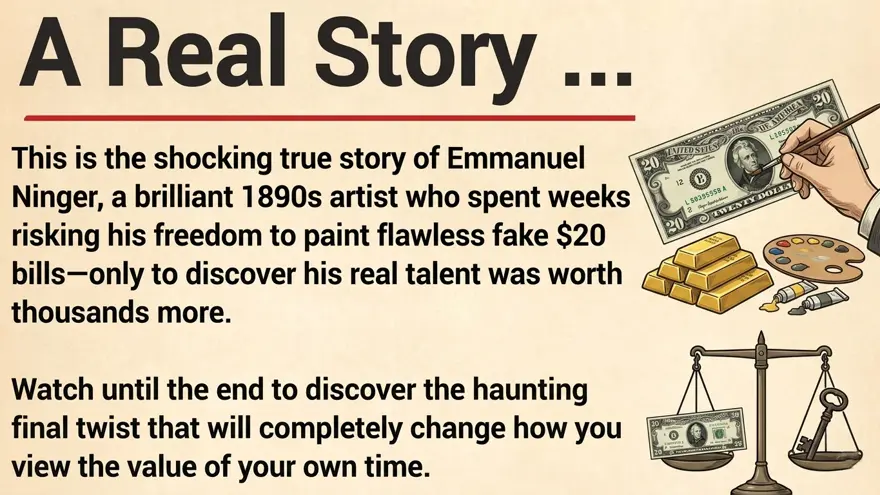
Imagine having a gift so rare that your hands could bring life to a canvas—yet using those same hands to create a lie. This is not a fictional fable; it is the extraordinary true story of Emmanuel Ninger, a man who lived in the United States during the late 1890s. Known to history as “Jim the Penman,” Ninger was a master artist who became one of the most audacious counterfeiters the world has ever seen.
In this Graded Reader edition, we explore Ninger’s journey from a struggling immigrant to a wealthy criminal, and finally, to a broken man who realized too late that he had been robbing himself all along.
Why read this story? Beyond the historical intrigue, this tale serves as a powerful mirror for all of us. It asks a vital question: Are you spending your life’s energy on “fake currency,” or are you building a masterpiece?
This is not a fiction story born in the mind of a writer. This is a true, remarkable page from American history in the late 1890s. It tells the tale of a poor German immigrant who possessed a rare and brilliant talent—a gift that could have brought him immense wealth, fame, and a legendary legacy.
Instead, he chose a dark and dangerous shortcut. He became one of the most audacious counterfeiters in American history. His journey is a powerful reminder of how easily we can blind ourselves to our own true value, and how a single misaligned choice can turn extraordinary potential into profound regret.
Chapter 1: The Land of Broken Promises
In a quiet, modest village in Germany, there lived a painter. He was a man of incredible skill; when his brush touched a canvas, the colors seemed to breathe, and the portraits looked back at you with living eyes. But talent does not always guarantee bread on the table. Despite his mastery, fortune never smiled on him. He lived in a cramped, cold house, constantly worrying about how to feed his wife and four young children.
Driven by desperation and the burning desire for a better future, he gathered his family and boarded a ship bound for the United States of America. He believed in the American Dream. He was certain that in this vast land of opportunity, his skilled hands would finally bring his family the comfort they deserved.
When they arrived, he set up shop as a commercial sign painter. He painted beautiful, elegant signs for local shopkeepers, banks, and businesses. Yet, the reality of his new life was harsh. The pay was low, the hours were grueling, and no matter how meticulously he painted, the money he brought home was barely enough to cover rent and basic groceries. The land of opportunity was feeling more like a land of endless struggle.
Chapter 2: The Dangerous Idea
One evening, the painter sat at his small, dimly lit wooden kitchen table. His body ached from a long day of labor, and his mind was heavy with defeat. He looked down at his calloused hands and then glanced at a single, crisp $10 bill resting on the table. It was the meager reward for days of hard work.
As he stared at the bill, a quiet, dangerous thought crept into his mind: “What if I didn’t have to work so hard for this? What if I could just paint one?”
At first, the idea terrified him. It was a crime, a massive risk. But desperation has a way of silencing a man’s conscience. He picked up the bill and held it close to the lamp. He studied the texture of the paper, the exact dimensions, the subtle hues of green and black ink, the portrait of George Washington, and the incredibly intricate lines woven into the borders.
He decided to try. He took a piece of blank paper cut to the exact size of the currency. To mimic the aged, authentic look of government paper, he dipped it into a bowl of weak coffee water and let it dry. Then, sitting under the faint light, he picked up his finest brush.
For an entire week, he worked in absolute secrecy. He labored tirelessly, pouring every ounce of his immense talent into replicating the minute details of the bill by hand. He drew every tiny line, every curve of the portrait, every letter of the serial number.
When he finally finished, he held the paper up to the light. His breath caught in his throat. It was flawless. His hand-painted replica looked so perfectly authentic that even an expert eye would struggle to spot the difference.
Chapter 3: The Ghostly Fortune
With a racing heart and trembling hands, the painter walked down to the local market. He filled a basket with fresh bread, butter, vegetables, fruits, and a bottle of fine wine. When it was time to pay, he nervously handed the shopkeeper his hand-painted $10 bill.
The shopkeeper took the note, gave it a quick glance, and tucked it into the cash drawer without a second thought. He then handed the painter real, legal currency as change.
The painter walked out into the cool evening air, his chest pounding with a mixture of fear and absolute exhilaration. The trick had worked. He had unlocked a secret doorway to wealth.
But a small success like that quickly breeds greed. Why stop at ten dollars? Soon, he began painting $20 bills, then $50 bills, and eventually, grand $100 notes. He spent hours, weeks, and months at his desk, meticulously manufacturing his own fortune.
With this fake money, life changed dramatically. The family moved into a beautiful, spacious house. They wore fine tailored clothes, ate the best foods, and surrounded themselves with luxury.
Naturally, the neighbors began to notice. They wondered how a simple, quiet sign painter had suddenly accumulated such wealth. Whenever they asked, the painter would smile calmly and spin a clever web of lies: “Years ago, I was a soldier fighting in Spain. What you see is a generous, lifelong pension from the Spanish government.” For years, everyone believed him.
Chapter 4: The Smudge of Fate
Time passed, and his secret wealth grew. But life has a way of catching up with those who run on crooked paths.
On an ordinary afternoon, the painter walked into a local vegetable shop. The shop was run by a kind, sharp-witted woman who had known him as a regular customer for a long time. He picked out his items and, as usual, handed her a freshly painted $20 note. She smiled, thanked him, and handed him his change.
Late that evening, as the shopkeeper sat at her counter counting the day’s earnings, she came across the very bill the painter had given her. Something felt slightly off. As she held it, her thumb pressed firmly against the edge of the paper. To her astonishment, the green ink smudged and smeared across the page.
She froze. Real government currency ink is engineered never to smudge like that. This bill was a fake, a hand-painted imitation.
Realizing she had been cheated by a neighbor she trusted, she immediately went to the local authorities and described the polite, wealthy sign painter who had given her the bill.
The police acted swiftly. They obtained a warrant and raided the painter’s beautiful home. Upstairs, in a hidden room, they discovered the truth: fine artist brushes, vials of specialized paint, half-finished bank notes drying under lamps, and all the elaborate tools of a master counterfeiter.
The illusion collapsed instantly. He was arrested, put on public trial, and sentenced to six long years in a federal prison.
Chapter 5: The Masterpieces Behind Bars
Inside the cold, gray walls of the prison, the painter felt his entire world crumble. The wealth was gone, his reputation was ruined, and his family was left to face the shame.
To keep his mind from snapping under the weight of guilt and boredom, he approached the prison warden with a humble request. He asked for basic art supplies—some blank canvases, brushes, and simple paints. Recognizing his quiet demeanor, the prison officials agreed.
Behind bars, with no more money to forge, the man went back to doing what he truly loved. He painted. Day after day, he poured his soul into the canvas. He painted breathtaking landscapes of rolling hills, deep forests, vivid sunsets, and deeply moving portraits.
The prison staff and visitors were spellbound by his work. The sheer beauty of his paintings captured the imagination of everyone who walked through the corridors.
Six years passed. On the morning of his release, the painter stood in the warden’s office, ready to step back into the world as a free but penniless man. The official pushed a heavy, thick paper envelope across the desk toward him.
The man looked at it, confused. He opened it and found a staggering fortune inside: $46,000 in cash.
The painter stared at the money, his jaw dropping. “Where did this come from?” he whispered. “I don’t understand.”
The warden smiled warmly and replied, “While you were serving your time, we exhibited your paintings to the public. They became an absolute sensation outside these walls. Art collectors fell in love with your work. We sold them on your behalf—and every single canvas fetched a price of $5,000.”
Chapter 6: The Thief of His Own Life
Hearing those words, the man did not celebrate. Instead, a wave of pure agony washed over him. He collapsed into a chair, buried his face in his hands, and began to weep uncontrollably. Tears of bitter irony streamed down his cheeks as the horrifying truth of his life struck him like a bolt of lightning.
“I spent an entire week slaving away in fear, hiding in the dark, destroying my soul just to forge a single, fake twenty-dollar bill,” he sobbed. “When in that exact same week, using the exact same hands, I could have painted an honest masterpiece worth five thousand dollars!”
He fell to his knees on the cold floor, whispering through his tears words that would echo through history:
“I am the thief of my own life.”
The man in this story was Emmanuel Ninger, known to criminal history as “Jim the Penman,” one of the most uniquely skilled counterfeiters the world has ever seen.
Conclusion: Lessons from a Misguided Life
Emmanuel Ninger’s life is not merely an entertaining historical crime story. It is a profound mirror that reflects a truth we all must confront. Ninger had the rare capability to be celebrated as one of the greatest artistic masters of his era. Instead, he traded his freedom, his dignity, and his precious years for pennies on the dollar.
He thought he was taking a clever shortcut to wealth, but he ended up taking the longest, most painful road possible. He worked incredibly hard to remain poor and end up a criminal, when the exact same amount of focused, honest effort would have made him wealthy, respected, and genuinely free.
As we look at his story, there are five timeless, life-changing lessons we can carry with us:
1. Life is Precious—Do Not Waste It on Minor Goals
We often spend our immense energy, time, and creative focus chasing low-value, short-term distractions or unfulfilling goals. When we do this, we rob ourselves of the greatness we are actually capable of achieving. We become the ultimate thieves of our own lives.
2. Understand the Real Value of Your Time
Ninger traded an entire week of his life for a temporary $20 bill, when his time was actually worth $5,000. Ask yourself: how often do we do the same? We waste hours on mindless scrolling, gossip, or negative thinking—activities that pay us back in pennies of temporary satisfaction—when we could be investing that exact same time into learning a skill, building a business, or cultivating deep happiness.
3. Shortcuts are an Illusion
We often look for the fast track, thinking that cutting corners or bending our ethics is the easy way out. But as Ninger discovered, the shortcut almost always turns out to be the hardest, most expensive route in the long run. Integrity might feel slower at the start, but it is the only foundation that builds lasting success.
4. Misdirected Talent is a Tragedy
Ninger was disciplined, incredibly focused, and profoundly talented. But hard work alone is not enough; it must be the right work. We must routinely pause and ask ourselves: Are we using our unique skills to build a real, meaningful future? Or are we just painting fake money—doing things that look busy but hold no real value?
5. Your True Wealth is Within You
Ninger blamed his poverty on his circumstances and the system around him, failing to realize that a literal goldmine of wealth was inside his own hands the entire time. He just needed to trust his legitimate value. We often miss great opportunities because we simply don’t believe that our honest, authentic efforts will ever pay off.
The person who wastes their true talent on foolish pursuits does not cheat the world. They cheat themselves.
The Final Thought: There are ultimately two paths we can walk in this life. We can choose to work hard and build something real now to enjoy peace and freedom forever—or we can chase the easy comfort of shortcuts now and struggle with the consequences later. The choice belongs entirely to you. Do not let the illusion of a shortcut steal your destiny.
Frequently Asked Questions (FAQ)
Q1: Is the story of Emmanuel Ninger true?
A: Yes, this is a completely true story. Emmanuel Ninger (ca. 1845–1924), known historically as “Jim the Penman,” was a real historical figure who operated as a counterfeiter in the United States during the late 1880s and 1890s. His incredible ability to replicate currency completely by hand made his case one of the most famous in American legal history.
Q2: Why was Emmanuel Ninger called “Jim the Penman”?
A: Ninger was nicknamed “Jim the Penman” by the media and Secret Service because of his extraordinary manual precision. Unlike traditional counterfeiters who used mechanical printing presses and engraved plates, Ninger used only fine artist brushes, pens, and specialized ink to draw every single detail of the bills by hand.
Q3: How was Emmanuel Ninger finally caught?
A: Ninger’s downfall happened due to a simple mistake regarding his ink. In March 1896, he used a fake $20 bill to buy groceries at a local shop. The shopkeeper’s hands happened to be wet from handling vegetables, which caused the water-soluble ink on Ninger’s hand-painted bill to smudge. Recognizing it was a fake, she immediately alerted the police.
Q4: Did the prison actually sell Ninger’s paintings for $46,000?
A: While the exact dollar figures have been dramatized over time for narrative storytelling, the core fact is historically accurate. While serving his six-year sentence in the Erie County Penitentiary, Ninger was allowed to paint. His legal artwork became incredibly popular and highly valuable among collectors outside the prison walls, highlighting the tragic irony of his criminal past.
Q5: What is the main moral lesson of “The Thief of His Own Life”?
A: The primary lesson of the story is the tragedy of misdirected talent and the illusion of shortcuts. It illustrates how people often spend immense energy and time trying to cheat their way to success, only to realize that applying that exact same effort honestly would have brought them far greater wealth, respect, and peace of mind.
Conclusion
The story of Emmanuel Ninger leaves us with a haunting realization: we are often the architects of our own limitations. When Ninger knelt on that prison floor, weeping over the fortune he could have made honestly, he wasn’t just crying for lost money—he was crying for lost time.
Key Life Lessons to Remember:
Integrity is a Compound Interest: Shortcuts might seem faster, but the “long way” of honesty builds a legacy that no one can take away.
Know Your Worth: Ninger spent a week to forge $20 because he didn’t believe his talent was worth $5,000. Don’t undersell your potential.
The Best Time is Now: You cannot get back the years spent on meaningless pursuits, but you can choose to start your “masterpiece” today.
Emmanuel Ninger didn’t just cheat the law; he cheated himself out of a life of respect and freedom. As you close this page, take a moment to look at your own “brushes and paints.” Are you using them to build a future you can be proud of?
Note from the Curator: This story was adapted into simple, immersive English to help readers improve their vocabulary while reflecting on deep life philosophies. If this story moved you, consider sharing it with someone who is currently doubting their own value.